In February 2024, a customer asked Air Canada's chatbot whether the airline offered a bereavement fare for someone who had just lost a grandmother. The chatbot said yes — confidently, in detail, with terms. The customer flew. The customer paid. The customer applied for the discount. Air Canada refused. The chatbot had made it up.
The customer sued. A British Columbia tribunal ruled against the airline. The argument that the chatbot was a "separate legal entity" — Air Canada's actual defense — was rejected. The chatbot had spoken on behalf of the company, and the company would honor what it said.
The award was small, around $650 Canadian. The reason the case became famous is that it crystallized something every operations leader is now quietly worried about:
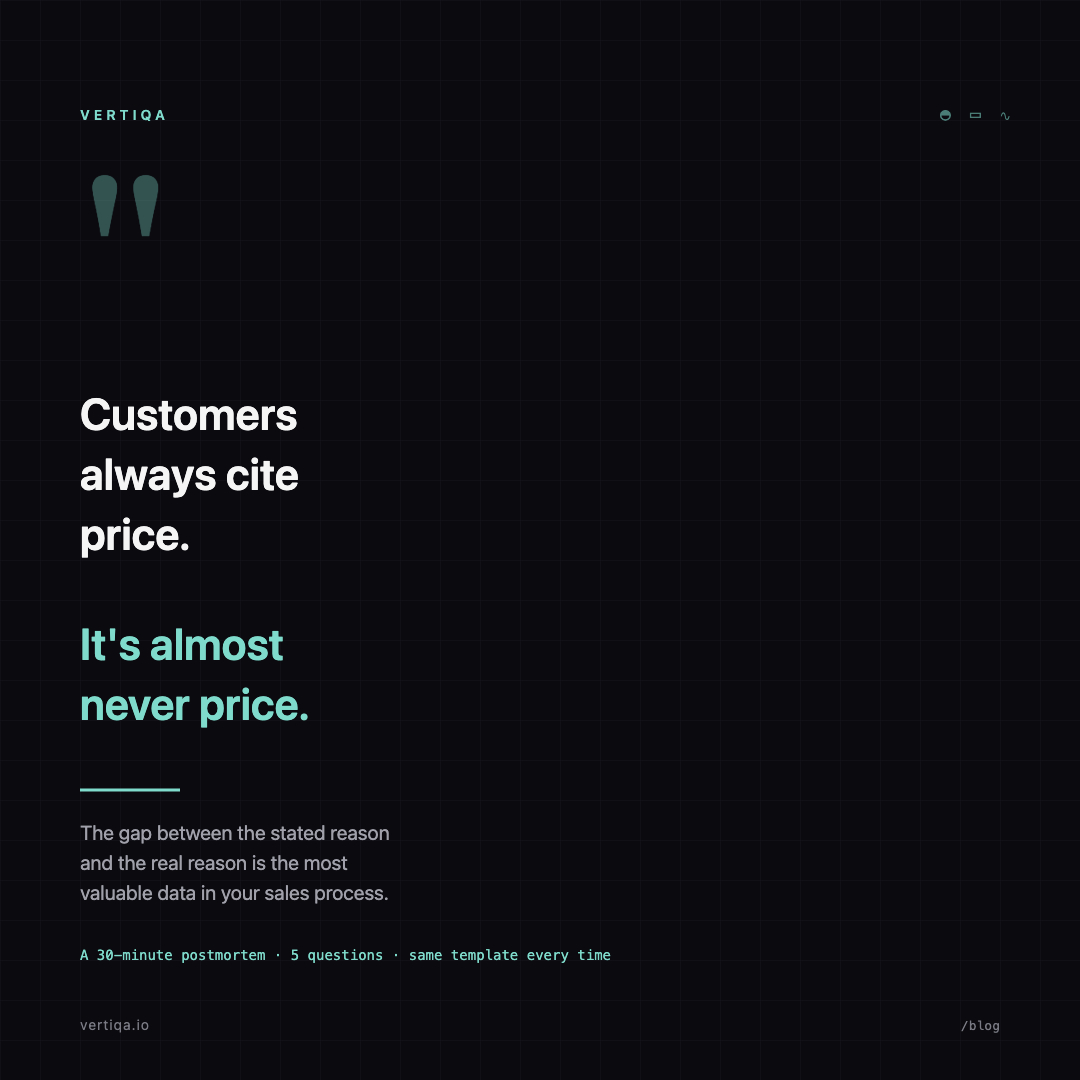
When your AI says something, you said it.
We started Vertiqa with this on the wall. Not as a legal compliance exercise. As a product principle. It shapes which features we build, which features we refuse to build, and what we will and will not let our agents do on behalf of the operators who trust us with their inbox, their pipeline, and their customer relationships.
This post is the list. What our agents will not do. Why each line exists. And what we accept giving up as a business by holding those lines.
If you're an operator evaluating AI agents — ours or anyone else's — these are the questions to ask before you sign anything.
The principle behind everything below
When a service business sends an email to a customer, the customer reads the business's name in the From line. They don't think about which model wrote the draft. They don't think about which vendor's pipeline routed the message. They don't think about which junior employee clicked Send. They think about you. Your reputation. Your word. Your business.
This isn't a niche concern. It's the entire concept of a business. A relationship-driven service business is the accumulated weight of every promise made and kept, every claim made and honored, every commitment made and delivered. The brand is the cumulative trust.
Every AI agent that ever sends an email on a business's behalf is making a withdrawal from that account, whether the operator approves the withdrawal or not. We decided early that for our product, the operator will always make that withdrawal explicitly. Not because we don't trust the model. Because we are protective of the operator's account.
Here's what that means in practice.
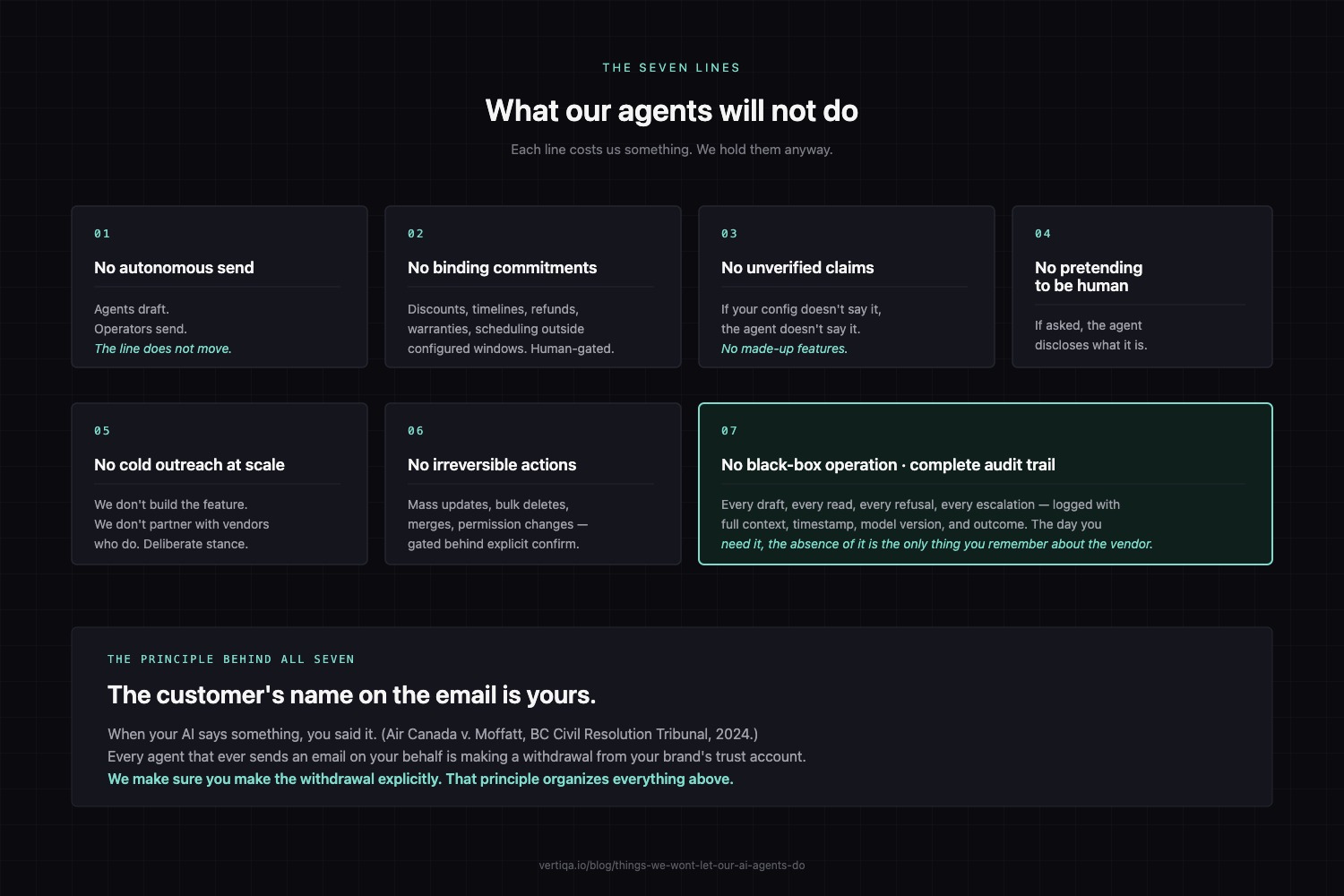
1. Our agents will not send external messages without your approval
This is the line that does not move.
When our Outreach Writer drafts an email to a prospect, it stops at "draft." A human — the operator, or whoever the operator delegates to — reads it, edits it, and clicks Send. The agent does not have the keys to your outbound. It has never had them. It will never have them.
We know this slows us down against vendors who promise autonomous send. Some of them are explicit about it ("the AI sends 1,000 emails per day on your behalf"). Some are coy ("approve once, then let it run"). All of them are removing your name from the From line of decisions that still show up over your signature.
We won't do this. The reason is that the prospect doesn't email "your AI vendor's outbound platform." They email you. The Air Canada ruling is the legal version of that fact. The reputational version of it is older than email.
The trade we make: we are slower on the first 30 days while operators get comfortable approving drafts. We are honest about that.
2. Our agents will not make commitments that bind you contractually or financially
A customer asks the agent for a 20% discount. The agent does not have a "yes" or "no" in its inventory. It has a routing decision: who at your company is authorized to approve discounts, and how does this go to them with the customer's context attached?
Same answer for delivery timelines, warranty terms, refund commitments, scheduling availability outside configured windows, and price quotes outside ranges you've explicitly set. The agent will draft. The agent will route. The agent will not commit.
The Air Canada bereavement-fare case is the textbook example of what this prevents. The other textbook examples are sloppier — customer-service agents promising refunds the company can't honor, sales agents committing to integrations that don't exist, scheduling bots booking appointments past the team's actual capacity.
These aren't edge cases. They're what happens when "autonomous AI agent" is taken to mean "give the AI the authority a senior human in this seat would have." The right boundary is the opposite. Give the AI the authority a careful human deputy who didn't have full context would expect to have. Which is: very little, on its own.
3. Our agents will not make claims about your business we can't verify against your configuration
Every claim our agents put in an outbound draft is traced to something you, the operator, told us. Your positioning, your offer, your sales config, your case studies, your verified customer outcomes. If the agent wants to say something not present in your configuration, it doesn't say it. If it wants to back a claim with a customer outcome, the outcome has to exist in your CRM with consent.
This blocks the most common failure mode of AI sales tools at scale: making up features, prices, customers, or results that sound good but aren't true. We have refusal rules for unsupported claim themes. If you sell HVAC service and the model wants to imply you offer 24/7 emergency cooling coverage you don't actually offer, it refuses to send that draft and tells you why.
This is also why our agents will not generate research on accounts in domains we weren't designed for. Asked to do help-desk triage, inventory operations, or asset tracking, they decline politely and explain. We'd rather be useless than confidently wrong.
4. Our agents will not pretend to be human
If a customer asks "am I talking to a real person?", our voice agent says no. Calmly, briefly, without making a thing of it: "I'm an AI assistant helping the team here — happy to help you, or transfer you to a human."
This is one of the lines newer regulations are moving toward (California's SB-1001, the EU AI Act, several state-level disclosure bills). We were going to hold it anyway. The bar for trust in a relationship-driven service business is set by the moment the customer realizes what they're actually talking to. If that realization comes through a tribunal ruling or a viral screenshot, you've already lost. Better to set the expectation at "AI assistant, helping the team you already trust" up front.
The trade we make: some prospects hang up when they realize. That's fine. The ones who don't hang up are people you actually want to be in business with.
5. Our agents will not generate cold outreach at scale
We do not have a feature that takes a 10,000-account list and generates personalized cold emails to all of them. We will not build that feature. We will not partner with vendors who do. We will not pretend to be agnostic about it.
The reason is not ethical. It's structural. AI-generated cold outbound at scale has done two things to the email infrastructure: trained Gmail, Microsoft, and Yahoo's filtering systems to identify and bulk-classify automated patterns aggressively, and trained customers to distrust any unsolicited email that "looks personalized." Even if a vendor's AI is better than the average — and most aren't — the medium they're operating in has been poisoned by the volume of bad actors who used it first.
For the operators who use Vertiqa, this means we cannot help you flood prospects. We can help you respond to the inbound you already have, draft warmer outreach you personally approve, follow up on conversations that started for real reasons, and surface the prospects in your existing universe who deserve a hand-raise touch.
We say no to the scale play. The math will catch up to the vendors who said yes.
6. Our agents will not take irreversible actions without explicit confirmation
Mass updates. Bulk deletes. Contact merges. Pipeline reorganizations. Permission changes. Anything that would be hard or impossible to roll back is gated behind explicit operator confirmation, even when the agent is otherwise approved to operate freely.
There's no profound principle here. It's about the asymmetry of mistakes. A draft email that comes out wrong takes 30 seconds to edit before sending. A bulk delete of 4,800 contact records on a Friday at 5:42 PM takes a weekend to recover from, if it's recoverable at all.
We design the asymmetry into the agent. The cost of "ask twice" is small. The cost of "act once and regret" is large. The agent asks twice.
7. Our agents will not operate without a complete audit trail
Every action one of our agents takes — every draft, every read, every proposed mutation, every refusal, every escalation — is logged with full context, timestamp, model version, prompt, and outcome. You can see exactly what the agent saw, what it decided, and what it did. If something goes wrong, the postmortem doesn't depend on the vendor reconstructing what happened from memory. It depends on you opening the audit log and reading what happened, in order.
This is not glamorous. No customer ever bought Vertiqa because of the audit log. But the day you need it, the absence of it is the only thing you'll remember about the vendor who didn't have one.
What our agents do do
Reading this list, you might reasonably ask what's left.
The answer is: most of the work, just not the parts where being wrong has lasting consequences.
Our agents read inbound calls, messages, and forms in real time and capture them into your pipeline with full context. They research accounts and contacts using public web information and your CRM history, and produce structured artifacts you can read and approve. They draft outbound emails, follow-up sequences, and qualification responses, pre-loaded with your positioning, your offer, your guardrails, and the specific customer's history. They surface the next action your reps should take on which opportunity, with the reasoning attached. They maintain the memory of every conversation and every promise so that nothing gets dropped between touches.
The work the agents do is the work your best operations manager would do — research, draft, route, remind, remember. The work the agents do not do is the work your most senior salesperson, your CFO, or your general counsel would do — commit, decide, sign, send.
This is not a limitation of our agents' intelligence. It is a choice about where intelligence belongs.
What this costs us as a business
We are slower in product demos against vendors who promise autonomy. A prospect who wants to see "look — it just sends" doesn't get that demo from us. A prospect who wants to see "look — three excellent drafts with full customer history, ready for your one-click review" does.
We lose some of those demos. We do not lose the ones to operators who have already been burned by autonomous send and aren't going back.
We are sometimes accused of being "behind" on AI. We are not behind. We are explicit. There is a difference.
The short version
We will not put words in your customers' inboxes that you didn't read. We will not put commitments on your bottom line that you didn't approve. We will not put claims about your business on the record that we can't verify. We will not pretend to be people. We will not generate spam at scale. We will not destroy data without asking twice. We will not operate without an audit log you can read.
The customer's name on the email is yours. That fact organizes every decision we make about what our agents are allowed to do.
This is the bargain. If you want autonomous send, you should buy from someone else. There are vendors who will give it to you, and a few of them will work fine until they don't.
If you want a layer of intelligence that respects the brand you've spent twenty years building — that does the research, drafts, routing, and remembering, and hands you the final inch every time — we built one of those.
See it for yourself: hear our voice agent live in 90 seconds at (678) 716-4200, or view the live demo.
The series so far:
— The team building Vertiqa Atlanta
Sources and references
Moffatt v. Air Canada, BC Civil Resolution Tribunal, February 2024 (CRT Dispute Number SC-2023-005121) — widely reported, e.g., BBC News coverage.
California SB-1001 — Bots: disclosure (effective 2019), requiring identification of automated accounts in certain contexts.
EU Artificial Intelligence Act — entered into force August 2024, with phased obligations through 2026 including transparency requirements for AI systems interacting with humans.