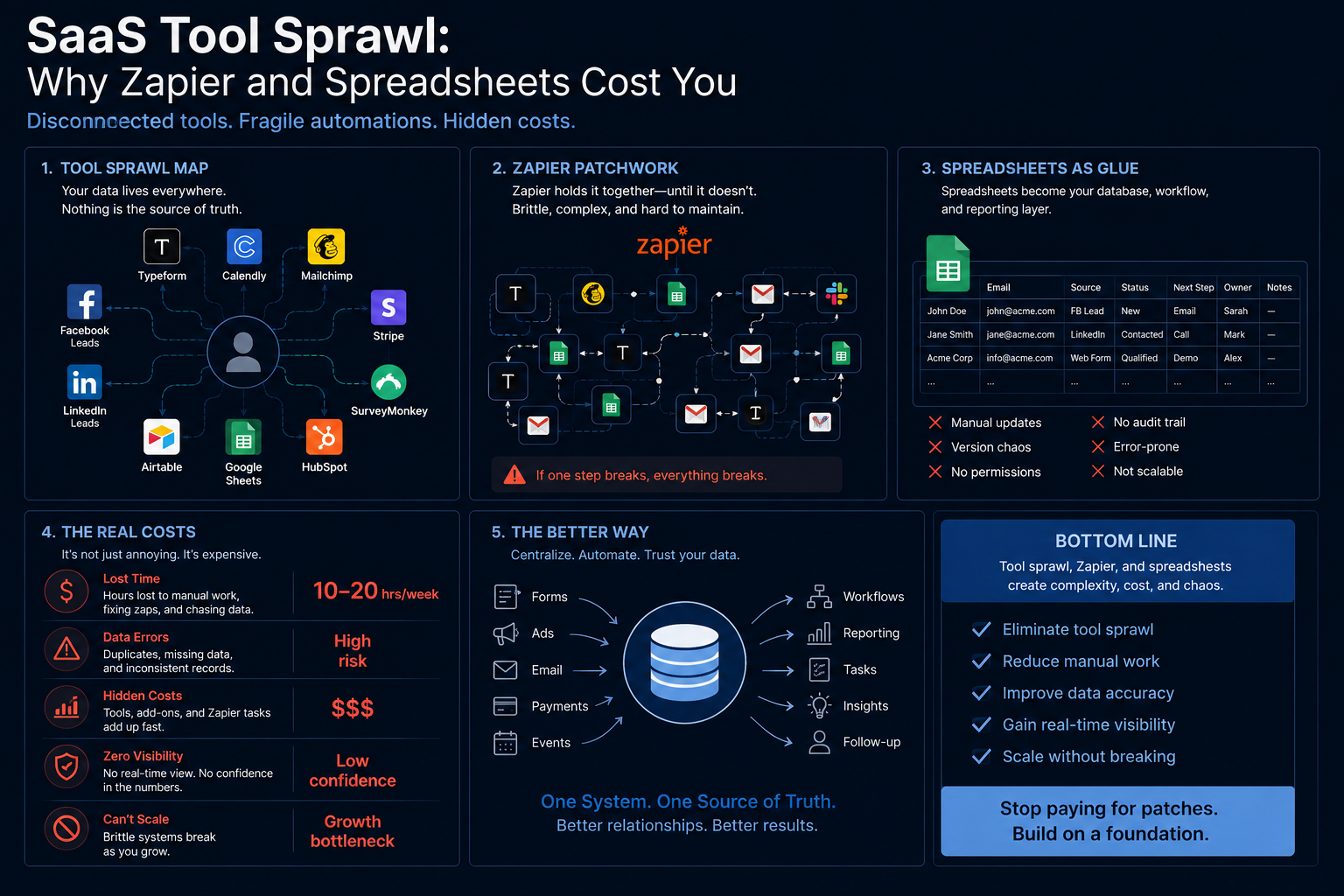
Most service businesses run on what we call a stitched-together stack: somewhere between 8 and 20 software tools, held together by Zapier, a few Google Sheets, copy-paste, and the owner's memory. It looks like it works. The dashboard goes green. The invoices go out. The work gets done.
Underneath, the business is paying a tax. The tax is paid in dropped customers, missed renewals, late follow-ups, and the slow erosion of relationships that nobody quite tracks because no single system owns the relationship.
This post defines what a stitched-together stack actually is, walks through a real example of a 6-person service business and shows exactly where the tax shows up, names the five signs you're paying the tax in your own business, and lays out what an alternative architecture looks like.
If you have ever felt like your business is busier than ever and shipping less than it used to, this is for you.
What is a "stitched-together stack"?
A stitched-together stack is a service business's collection of software tools when those tools don't share a common memory of customer relationships. Each tool handles one piece of the work — a CRM stores contacts, a phone system handles calls, a calendar handles meetings, a spreadsheet tracks something else — and the relationships between tools are held together by manual workflows, integration platforms like Zapier or Make, and the operator's working memory.
The standard stack in a small service business in 2026 includes some combination of:
A CRM (HubSpot, Salesforce, Pipedrive, or an industry-specific tool)
A field service management or scheduling tool (Jobber, Housecall Pro, Calendly)
Phone and SMS (Google Voice, RingCentral, OpenPhone, Twilio)
Email (Gmail, Outlook)
Calendar (Google Calendar, Outlook Calendar)
Quoting or proposal software
Accounting (QuickBooks, Xero, FreshBooks)
Marketing or email automation (Mailchimp, Constant Contact, ActiveCampaign)
Document storage (Google Drive, Dropbox, OneDrive)
A handful of Google Sheets that track things no tool owns
Zapier or Make to move data between everything above
When somebody calls this a "stack," the implication is that it works together. It doesn't. It's a stitched-together collection of independent systems, each operating on a fragment of the relationship, none of them holding the whole picture.
A real example: walking a customer through a stitched stack
Let's trace what actually happens when a single new customer interacts with a representative service-business stack. This example uses a 6-person specialty pest control company in the Atlanta metro area. The details are anonymized, but the workflow is real and we've seen variants of it across dozens of HVAC, lawn care, life insurance, senior living advisory, and equipment financing businesses.
The setup
The business runs on:
Jobber (field service management)
Google Calendar
Gmail
Google Voice (business phone)
A WordPress website with a Gravity Forms contact form
Google Sheets (for route planning, follow-up tracking, and what the owner calls "the renewal list")
QuickBooks Online
Mailchimp
Zapier (5 active Zaps)
Calendly (for scheduled service appointments)
Total: 10 distinct tools, plus Zapier as the glue.
The customer journey
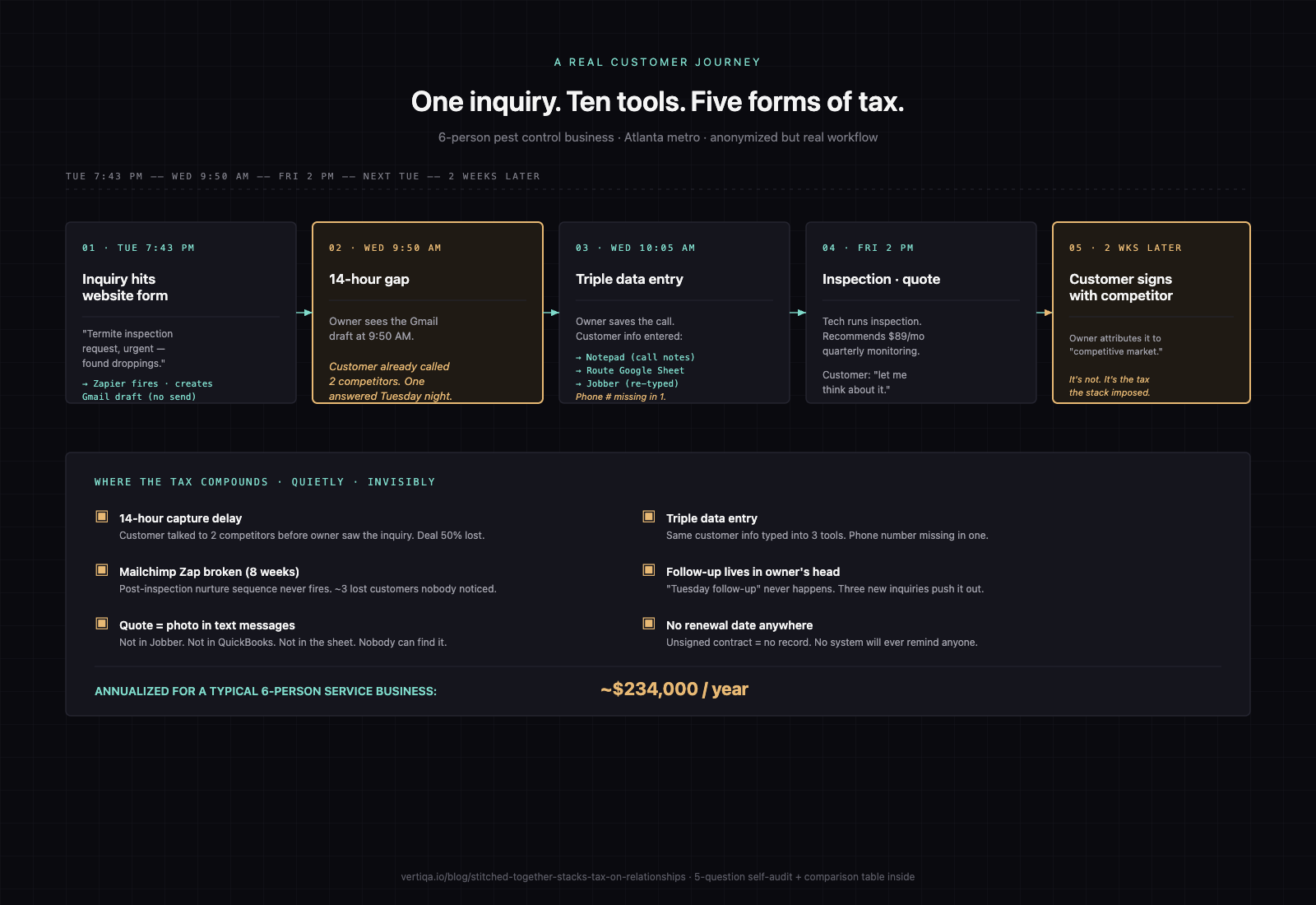
Step 1 — Inquiry. A homeowner in suburban Atlanta submits the website contact form on Tuesday at 7:43 PM. Subject: "Termite inspection request, urgent — found droppings."
Step 2 — Zapier fires. The form submission triggers a Zap. The Zap creates a draft email in the owner's Gmail inbox. The Zap does not send the email; it requires the owner to review and click send.
Step 3 — The 14-hour delay. The owner sees the Gmail draft Wednesday morning at 9:50 AM, when he opens his laptop. He calls the customer back. The customer has already called two competitors. One of them answered Tuesday evening. The deal is roughly 50% lost before the owner has finished his coffee.
Step 4 — The qualification call. The owner does win the conversation; the customer hasn't fully committed to the competitor. The call lasts 12 minutes. The owner takes notes on a notepad. He books an inspection for Friday at 2 PM using Calendly.
Step 5 — Calendly → Calendar → Sheet → Jobber. Calendly sends the confirmation. Another Zap pushes the event to Google Calendar. The owner opens the route-planning spreadsheet and types in the customer's address and the appointment time. He then opens Jobber and re-types the customer details into a Jobber job record so the tech who will run the inspection has the right context.
The same customer information has now been entered manually three times: in the notes from the call, in the route spreadsheet, and in Jobber. Each entry is slightly different. The phone number is missing from one of them.
Step 6 — The inspection. The tech runs the inspection Friday. Finds evidence of termites, no active infestation yet. Recommends quarterly monitoring at $89/month. The tech writes the recommendation on a paper estimate form and texts a photo of it to the owner. The customer says they need to think about it and will get back to him next week.
Step 7 — Where the tax compounds. Here is where the stitched stack does its quietest, most expensive work.
The owner intends to follow up the next Tuesday. He doesn't write it down. By Tuesday, three new inquiries have come in and he forgets.
The Zap that was supposed to add the customer to the Mailchimp "post-inspection nurture" list broke last week when Mailchimp updated its API. Nobody noticed. The customer never gets the follow-up email sequence.
The quote written on the paper form is not in Jobber, not in the spreadsheet, not in QuickBooks. It exists as a phone photo in the owner's text messages.
The renewal date for what would have been a quarterly monitoring contract does not exist anywhere because the contract was never signed. It will never trigger a reminder.
Two weeks later, the customer signs with the competitor who originally called them Tuesday night.
The owner never knows. He attributes the loss, when he thinks about it at all, to "competitive market." It is not. The loss is the tax the stitched stack imposed on a relationship the business had basically already won.
The five forms the relationship tax takes
If you read the example above and recognized your business, here is the same pattern abstracted. The stitched-together stack imposes a tax in five specific forms.
1. The capture delay tax
Inbound inquiries do not land in real time. They land via Zapier, into an inbox, where they wait for a human to read them and act. The fastest businesses in your market — the ones with a real-time capture layer — answer or call back in minutes. You take hours, or until next morning.
A 2026 industry analysis from PCN estimates the average small business loses around $126,000 annually to missed and delayed inbound. The capture delay tax is the single largest line item in the relationship tax for most service businesses.
2. The double-entry tax
The same piece of customer data — name, address, phone, service requested — gets entered manually multiple times across tools that should have shared it automatically. Each re-entry costs operator attention, introduces typos, and produces slightly inconsistent records across systems.
Most service businesses re-enter customer data three to six times for a single new customer. Multiply by your monthly volume and the labor cost is real, even before you account for the customer-experience damage from inconsistent records.
3. The broken-Zap tax
Zaps and Make automations are not maintained. They break when APIs change. They break when a field is renamed. They break when an account password expires. They break silently.
The owner finds out about a broken Zap one of two ways: either a customer complains about something that should have happened automatically, or a quarterly look-through reveals an automation that has been failing for weeks. Either way, the damage is already done. The broken-Zap tax is paid in customers who didn't get the email they should have gotten, renewals that didn't trigger, and follow-ups that didn't happen.
4. The memory loss tax
No tool in a stitched-together stack holds the whole relationship. The CRM has fields. The phone log has minutes. The notes app has fragments. The owner's head has the rest, and it leaks.
When a customer calls back six months later, the rep cannot quickly pull the prior conversation, the prior quote, the open follow-up, the family member who was mentioned, or the price they were comparing against. The customer feels the cold restart. Trust is recharged from a lower starting point.
This tax does not show up on any invoice. It shows up as the slow attrition of customers who used to be loyal.
5. The owner-as-glue tax
The most expensive tax is the one the owner pays in personal attention. The reason the stitched stack works at all is that the owner is the integration layer. They remember what fell through the cracks. They notice the broken Zap. They re-enter the missing field. They follow up on the dropped lead.
This works at low volume. It does not scale. At about 50-80 active customer relationships, the owner saturates. Past that point, the business grows by making each customer slightly worse. (See "the hidden cost of every tool you add" for the dollar math on this.)
Why "more integrations" doesn't fix it
The instinct, when you read the above, is to look for better integration. More Zaps. Higher-tier Zapier plan. Switch to Make. Build internal Python scripts. Buy an iPaaS platform.
This does not solve the problem. Three reasons.
Integrations move data, not memory. A Zap that updates a Salesforce record when a Jobber job closes moves the data. It does not give Salesforce the call audio, the tech's recommendation, the customer's hesitation, or the family member the customer mentioned. The memory of the relationship is still scattered.
Integrations are themselves a tool that adds to the stack. Zapier is software with its own login, its own monitoring, its own admin surface, and its own failure modes. Adding it to fix integration problems makes the toggle-tax math worse, not better. (Toggle tax calculator here.)
The fix is architectural, not integrative. What service businesses need is a single layer that captures across the channels, holds the memory, watches the clock on commitments, and surfaces the next action with full context. That is a different shape from "more glue between existing tools." It is the operating layer position we outline elsewhere on the site.
How to spot the stitched-stack tax in your own business
Five questions to ask yourself this week. If you answer "yes" to three or more, you're paying the relationship tax at a material scale.
Does a single piece of customer information (name, address, phone) get entered manually into more than one tool in your business? Yes = you're paying the double-entry tax.
In the last 90 days, has someone discovered a Zapier automation, a workflow, or an integration that had been broken without anyone noticing? Yes = you're paying the broken-Zap tax.
When a returning customer calls and your rep answers, can the rep pull the full relationship history (last conversation, last quote, last promise, last issue) in under 30 seconds? No = you're paying the memory-loss tax.
Do inbound inquiries received after business hours wait until the next morning for a response? Yes = you're paying the capture-delay tax.
Is the owner personally the integration layer — meaning when things slip through the cracks, you are usually the one who notices and recovers them? Yes = you're paying the owner-as-glue tax.
Three or more "yeses" is the threshold where the tax is large enough to be material. Five out of five is the threshold where you're running a structural risk that scales with your growth.
Stitched-together stack vs. operating layer
The architectural alternative to a stitched-together stack is what we call an operating layer — a single substrate that sits across your existing tools, captures every customer event in real time, holds the unified memory, watches the clocks, and surfaces the next action with context.
The difference, side by side:
Dimension | Stitched-together stack | Operating layer |
|---|---|---|
How inbound is captured | Manually by a rep, or via Zapier with delay | Automatically across phone, form, email, chat — in real time |
Where memory lives | Fragmented across 8-12 tools | Unified, queryable, time-aware in one substrate |
Who watches the clock on commitments | The owner, in their head | The layer, autonomously |
What happens when an integration breaks | Silent failure; discovered after damage | Same substrate; no integration to break |
What the rep sees when a customer calls | Tabs open in 6 tools, 30+ seconds to assemble context | Full relationship context, one screen, real time |
Who owns "what happens next" | The owner | The layer |
What scales | Until the owner saturates (~50-80 relationships) | As the business grows |
The operating layer is not a replacement for your CRM, your phone system, or your scheduling tool. It sits underneath them. Your existing tools stay useful for the things they were built for — pipeline forecasting, dispatch, billing — and they stop being the place where the relationship work happens.
This is what Vertiqa is. (View the live demo or hear the AI receptionist live at (678) 716-4200.)
What a service business actually loses to the stack tax
The stitched-stack tax compounds quietly. To make it concrete, here is a back-of-envelope for a typical 6-person service business in 2026:
Capture delay: 30 missed or delayed inbounds per month × 35% close rate × $900 average first-job revenue = $9,450 / month.
Double-entry: 80 new customers per month × 4 minutes of manual re-entry × 12 staff hours / month × $35 / hour fully loaded = $420 / month. (Small line, real line.)
Broken-Zap tax: Two automation failures per quarter, each costing ~3 lost customers at $1,500 first-year value = $3,000 / month ($9,000 / quarter, annualized).
Memory loss: Returning customer attrition. Hard to quantify directly, but most service businesses see 5-15% of returning-customer churn attributable to "cold restart" feel. At a $5,000 LTV and 200 active customers, even 5% attrition is ~$4,200 / month.
Owner-as-glue: Owner spends ~4 hours / week recovering from stack failures. At an opportunity cost of $150/hour (modest for an owner of a business this size), that is ~$2,400 / month.
Total: ~$19,500 / month, or ~$234,000 annually in relationship-tax cost for a representative 6-person service business.
These are estimates. They are also conservative. Run the numbers on your own business and the result will not flatter your stack.
Frequently asked questions
What's the difference between a stitched-together stack and an "integrated" stack?
An integrated stack is one where data flows between tools (usually via APIs or Zapier-style automation). A stitched-together stack is the typical real-world state of that integration: data flows some of the time, breaks the rest of the time, and the integration platforms themselves become tools that add to the stack rather than reducing it. "Integrated" is the marketing claim. "Stitched-together" is the reality.
Is Zapier bad? Should we stop using it?
No. Zapier is excellent at what it was built for: moving data between systems that have well-defined inputs and outputs. The problem is not Zapier. The problem is treating Zapier as the architecture of a customer relationship. Moving data between tools does not solve the architectural problem of nothing in the stack owning the relationship itself. Use Zapier for what it's good for; stop expecting it to solve a problem it was not designed to solve.
What's the alternative to a stitched-together stack?
A unified operating layer that sits across your existing tools, captures every customer event in real time, holds the memory, watches the clocks, and surfaces the next action. The operating layer does not replace your CRM, phone system, or scheduling tool — it sits underneath them and gives them a shared brain. (Detailed architectural diagnosis here.)
Won't an operating layer add yet another tool to my stack?
It is one more tool on the surface, but it removes the need for several others — including the integration glue (Zapier), the manual-tracking spreadsheets, and the owner-as-glue work. The net is fewer tools, less toggle tax, less context-switching, and a unified memory layer that none of the previous tools provided. (Toggle tax math here.)
How long does it take to consolidate a stitched-together stack?
For a typical small service business, the move from a 10-tool stitched stack to an operating-layer-plus-existing-tools architecture takes 4-8 weeks of operator attention. Most of the work is in (a) auditing what data lives where, (b) deciding which tools to keep and which to retire, and (c) training the team on the new shape. The technical implementation of the operating layer is usually the smallest part.
How do I know if I'm paying the relationship tax in my business?
Run the five-question audit in this post. If you answer "yes" to three or more, you are paying it at a material scale. If you want to put dollar figures on the loss, use our toggle tax calculator for the internal-friction side and our voicemail audit for the capture-delay side.
The short version
A stitched-together stack is what you have when 8-20 software tools are held together by Zapier, spreadsheets, and operator memory. It looks like it works. Underneath, it imposes a five-form tax on every customer relationship: capture delay, double entry, broken integrations, memory loss, and the owner's personal attention as the integration layer.
The tax compounds quietly. For a typical 6-person service business it runs to roughly $234,000 per year in lost revenue and operator attention.
The fix is not more integrations. It is a different architecture: a unified operating layer that sits across your existing tools, captures in real time, holds the memory, watches the clocks, and surfaces the next action with full context.
You can keep paying the tax. Most service businesses do. The math compounds quietly. Then it doesn't.
See the operating-layer alternative: view the live Vertiqa demo or hear the AI receptionist live at (678) 716-4200 — 90 seconds, no signup.
Related posts in this series:
A dozen apps. No driver. — the architectural diagnosis behind this post.
The hidden cost of every tool you add. — the CFO-grade math on what your stack actually costs, with a free calculator.
Your CRM isn't broken. Your follow-through is. — the entry-level manifesto.
Speed-to-lead is the whole game. — the research backbone behind the capture-delay tax.
— The team building Vertiqa Atlanta