We have an instinct to forget the deals we lose.
The mind protects you. Friday afternoon, the customer signs with someone else. By Monday morning, the loss has been quietly absorbed into "well, that's how it goes." A week later, it's a name you barely remember on a Salesforce report. A month later, you couldn't reconstruct what actually happened if you tried.
This is the most expensive instinct in business.
The companies that compound learn from every loss. Not by holding emotional post-action retrospectives. Not by blaming the rep. Not by trying to find a new tool to fix it. By running a 30-minute, structured postmortem on every closed-lost deal — every time — and aggregating the patterns until the structural reasons for losing become visible enough to fix.
This is the playbook for doing that. The template you'll use, the cadence to run it, the five questions you'll answer in each session, the four numbers that come out the other side, and the trap most teams fall into that turns the practice into theater.
If you have ever ended a quarter with pipeline down and not been able to say exactly why, this is for you.
Why most companies don't do this
Three reasons. All of them honest. None of them good enough.
It's uncomfortable. Looking at why you lost feels like assigning blame. Most managers can't run a no-blame postmortem because their instinct is to find the responsible party. The rep gets defensive. The team stops bringing losses to the meeting. The postmortem dies after three sessions.
It feels slower than running the next deal. "I'd rather use this hour to work on a deal I can win." The hour you don't spend on the postmortem comes back as the same loss, on a different deal, three months later. The compounding cost of not running it is invisible until it isn't.
The format is missing. Without a template, every postmortem is a different meeting. People wander. The conversation drifts to "we should improve our messaging" without specifics. By session four, nobody can remember what was decided in session two.
The fix to all three is the same. Make the postmortem a 30-minute structured ritual, not a debate. Same template every time. Same five questions. Same outputs. Same place to log them.
Once it's a ritual, the discomfort fades. Once the format is fixed, the conversation gets sharp. Once the outputs are logged, the patterns become visible.
When to run it
Two triggers.
Any closed-lost deal above your minimum threshold. Set the threshold by your business. For most service businesses, the right line is "any deal where a quote was sent." For B2B SaaS, it's typically "any deal we ran a demo on." The point: don't run postmortems on top-of-funnel ghosting. Run them on losses where you were actually in the running and the customer made a decision against you.
Any customer who churned within their first 12 months. First-year churns carry more signal than long-term churn because they're more likely to be about the sale (wrong fit, wrong promise, wrong onboarding) than about ongoing satisfaction.
For pace: aim to run the postmortem within 5 business days of the loss. Memory degrades fast. Beyond a week, you are getting reconstructed rationalizations, not memory.
The 30-minute template
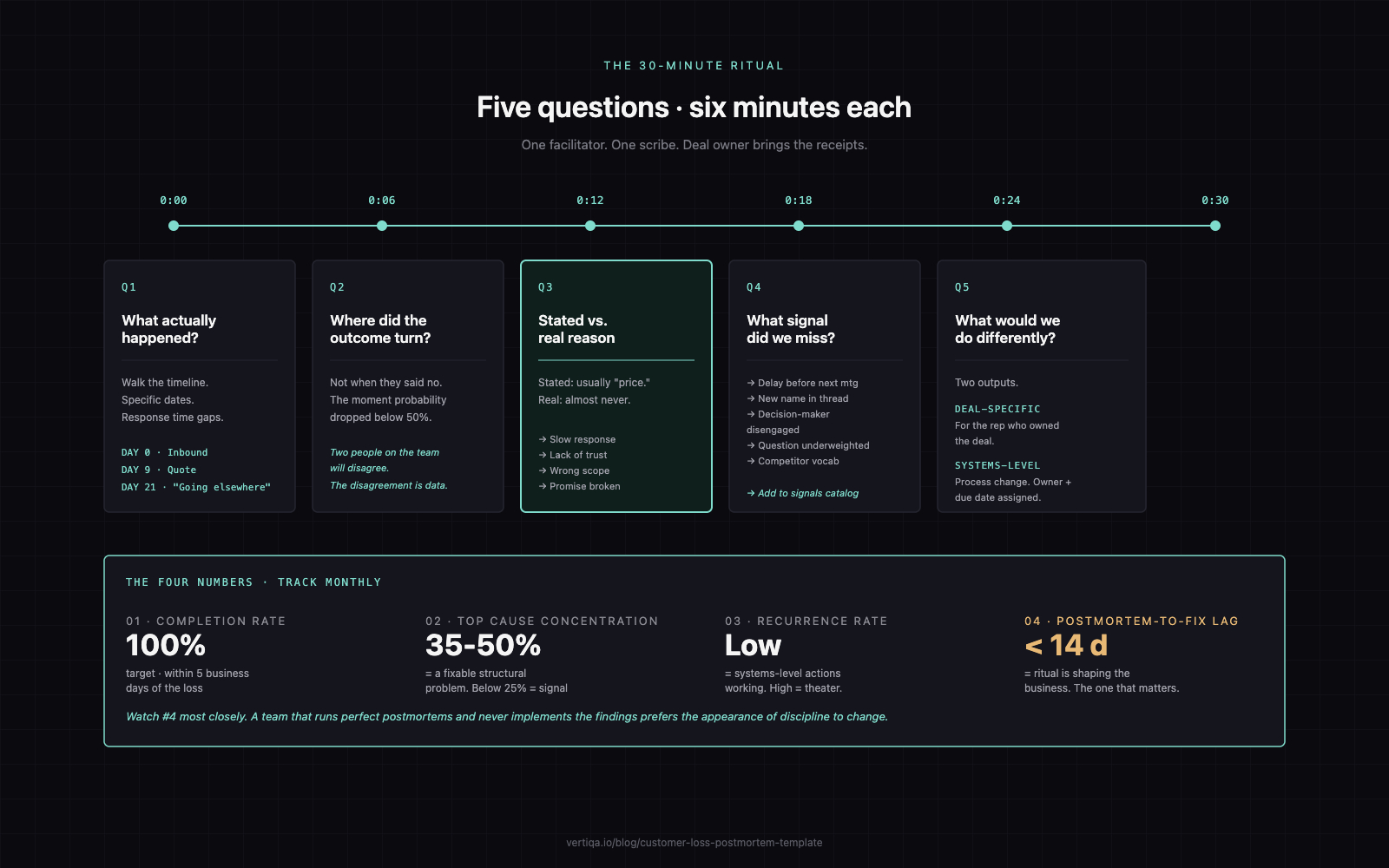
Five questions. Six minutes each. One person facilitates, one scribes, the deal owner attends and brings the receipts.
Q1 (0:00 – 0:06) — What actually happened?
Walk the timeline. First touch → qualification → first meeting → quote → follow-ups → loss notification. Use specific dates and durations. Identify response times.
This is the boring part. Do not skip it. Most of what you'll discover later is hiding in the timeline.
A working format:
DAY 0   · [date]  · Inbound (channel · source · who)
DAY 1   · [date]  · First conversation (length · key takeaways)
DAY 5   · [date]  · Qualification call (decision-makers identified)
DAY 9   · [date]  · Quote / proposal sent
DAY 14  · [date]  · Follow-up #1
DAY 21  · [date]  · "We're going with the other guys."
Look at the gaps between rows. The gaps are usually where the deal was lost, even when the loss notification comes weeks later.
Q2 (0:06 – 0:12) — Where did the outcome actually turn?
Not "when did we lose them," but "at what specific moment did the probability of winning go from above 50% to below 50%?"
This is the most important question in the postmortem. It is almost never the moment the customer told you no. It is some moment earlier — often a follow-up that didn't happen on time, a question that wasn't answered, a competitor introduction, or a price-shock that wasn't handled in real time.
The team should debate this one. Two people often disagree about when the outcome turned. The disagreement is the data. Write down both views. Patterns emerge across postmortems.
Q3 (0:12 – 0:18) — What did the customer say was the reason, and what was the real reason?
Customers almost always cite price. The real reason is almost always something else. Use this taxonomy:
Slow response. You took too long to come back with something they needed.
Lack of trust. Something specific made them doubt your competence or your honesty.
Wrong scope. What you proposed wasn't what they actually needed.
No clear next step. You ended a conversation without a specific, time-bound action.
Promise broken. You said you'd send something by X and didn't.
Competitor differentiation. They were genuinely more compelling on a dimension you didn't address.
Price (real). Price actually was the differentiating factor and you can substantiate it.
Internal change. A real budget freeze, leadership change, or priority shift on the customer's side. The only category where "out of our control" is honestly true.
Write down the customer's stated reason. Then independently, as a team, write down the real reason. The gap between the two is the most valuable data in your sales process.
Q4 (0:18 – 0:24) — What signal did we miss?
Almost every lost deal has at least one signal that, in hindsight, was visible at the time. Common ones:
A long delay before the next meeting got scheduled
A new name appearing in the email thread without explanation
The decision-maker quietly stopping direct engagement and routing through someone else
A specific question asked that you didn't take seriously enough
The customer starting to use a competitor's vocabulary
A late-stage scope question that should have been asked in discovery
A long silence that the rep waited out instead of breaking
The point is not to feel bad about missing the signal. It is to add the signal to a catalog of things you'll watch for next time. The catalog grows. Over months, it becomes a checklist that good reps run on every live deal.
Q5 (0:24 – 0:30) — What would we do differently?
Two outputs. A deal-specific answer and a systems-level answer.
Deal-specific: if we ran this exact deal again, what specific action would we take differently? This is for the rep who owned the deal. An individual lesson.
Systems-level: what should change in our process so this category of loss happens less often? This is for the team. Examples:
"Any deal that goes 7 days without a touch gets escalated automatically."
"We add a 24-hour follow-up to every quote with a scripted check-in."
"Every proposal includes the three most common objection responses inline."
"We change the discovery checklist to surface implementation timelines before the quote."
Write both down. Assign an owner to the systems-level action. Set a check-in date for two weeks from today.
What to do with the findings
A postmortem with no follow-up is a vent session.
Three places the findings have to land.
1. A loss log
Every postmortem produces one row in a shared sheet. Date, deal, value, customer-stated reason, real reason, signal missed, systems-level action assigned, owner, due date, implemented date.
The log itself becomes the single most valuable diagnostic asset in your sales operation within 90 days. It is the document a new sales hire should read on day one. It is the document you should bring to every quarterly business review. It is the document that makes structural problems undeniable when somebody on the leadership team wants to argue the issue is "rep performance."
2. A monthly patterns review (30 minutes)
Pull the last month's loss log. Look at the "real reason" column. Count by category. If "slow response" is 40% of your losses, you have a very different conversation than if "wrong scope" is 40%. Each category points to a different structural fix.
The monthly review is for the team that can fix structural things — usually sales leadership + ops + the founder. Reps don't need to attend. They need to know it happens.
3. The signals catalog
Maintain a single living document — call it "things we missed" — that aggregates Question 4 across postmortems. New entries get added after every session. Existing entries get marked when they recur.
Reps read it weekly. Over time it becomes the checklist that good reps run on every live deal. The catalog is also the single most useful onboarding asset you have for new sales hires.
The four numbers worth tracking
If you want to know whether your postmortem practice is working, track these monthly.
Postmortem completion rate. Postmortems run ÷ qualifying losses. Target: 100% within 5 business days. Below 80% = the ritual is slipping.
Top loss-cause concentration. What percent of losses fall into your single most common "real reason" category? If your top reason is 35-50% of losses, you have a fixable structural issue. Below 25% and your losses are diversifying, which is its own signal.
Recurrence rate. Percent of losses in the most recent month that match a "real reason" already flagged in the prior 90 days. High recurrence means you're learning but not fixing. Low recurrence means the systems-level actions are working.
Postmortem-to-fix lag. Median days between a systems-level action being assigned and being implemented. Above 30 days = the ritual is theater. Below 14 days = the ritual is shaping the business.
The first three are output metrics. The fourth is the operating discipline. Watch the fourth most closely. A team that runs perfect postmortems and never implements the findings is a team that prefers the appearance of discipline to the discomfort of change.
The no-blame framing (and how to actually run it)
The single biggest cause of postmortem failure is that they become blame sessions.
Three rules to prevent this.
Separate the deal from the rep. The deal is the subject. The rep is the witness. "Why did this deal stall in week 2?" is the question. "Why didn't you follow up faster?" is not.
Assume good faith. Every rep who lost a deal has a story for why. Take it at face value, then look for the system that produced the conditions for the loss. If the rep didn't follow up on time because she was on three other escalations, the systems-level question is about capacity allocation, not effort.
Look for the next-action, not the verdict. The point of a postmortem is not to decide who was at fault. The point is to decide what changes next.
When the meeting starts to drift into blame — and it will — the facilitator has one line to deliver: "Let's get back to the systems question. What changes in the process would have caught this earlier?"
Use the line. Use it every time. After a few sessions, the team will internalize the framing and the discomfort will fade.
When the postmortem reveals something structural
After 8-12 sessions, a pattern usually emerges that no individual deal change can fix. Common ones:
You're consistently slow on first response after inbound. (Connects to Speed-to-lead.)
Your reps are over-promising during qualification. (Connects to the Promise Journal.)
Your quote turnaround is too slow.
Your follow-up between proposal and decision is inconsistent.
You're being out-priced in the same segment repeatedly — pricing might be structurally wrong, not just tactically wrong.
You're losing on scope clarity — your discovery process isn't catching the actual requirements.
When you see one of these, stop running individual postmortems for a session and run a structural review instead. The structural fix is bigger than any single deal. The postmortem ritual surfaced the problem; a structural review is what fixes it.
Why this connects to everything else
Customer-loss postmortems are the diagnostic version of the rest of the operating discipline we write about.
If you've audited your voicemail (capture leak), measured your speed-to-lead (response leak), tracked the toggle tax (internal friction), run the first-10-minutes ritual (intake quality), and kept a promise journal (commitment discipline), the postmortem is where you verify whether all of that is actually working. The losses tell you which of your disciplines are real and which are theater.
The companies that run all of these together compound quietly for years. Their close rates rise without their marketing spend rising. Their churn rates drop without a customer success team being hired. Their reputations grow without a press release.
The reason: they are the only companies in their market actually learning from what's not working.
The short version
Five questions. Thirty minutes. One facilitator, one scribe, the deal owner with the receipts. Same template every time. Logged afterward. Patterns reviewed monthly. Structural fixes assigned with owners and dates.
Trigger on every closed-lost deal that mattered. Run within five business days. No blame.
The loss log and the signals catalog become the most valuable assets in your sales operation within 90 days.
Start with the next loss. Don't wait to set up a perfect process — that's the same procrastination dressed up as planning.
Download the Postmortem Template + Loss Log — printable template, fillable log with auto-calculated metrics, and a monthly patterns view. Use the next loss to start.
The tactical playbook series:
How many leads is your voicemail actually eating? — diagnose capture leaks
The first 10 minutes of an inquiry call. — intake discipline
The promise journal. — track what you owe people
Speed-to-lead is the whole game. — the research backbone
See the operating layer side: view the live demo or hear the AI receptionist live at (678) 716-4200.
— The team building Vertiqa Atlanta