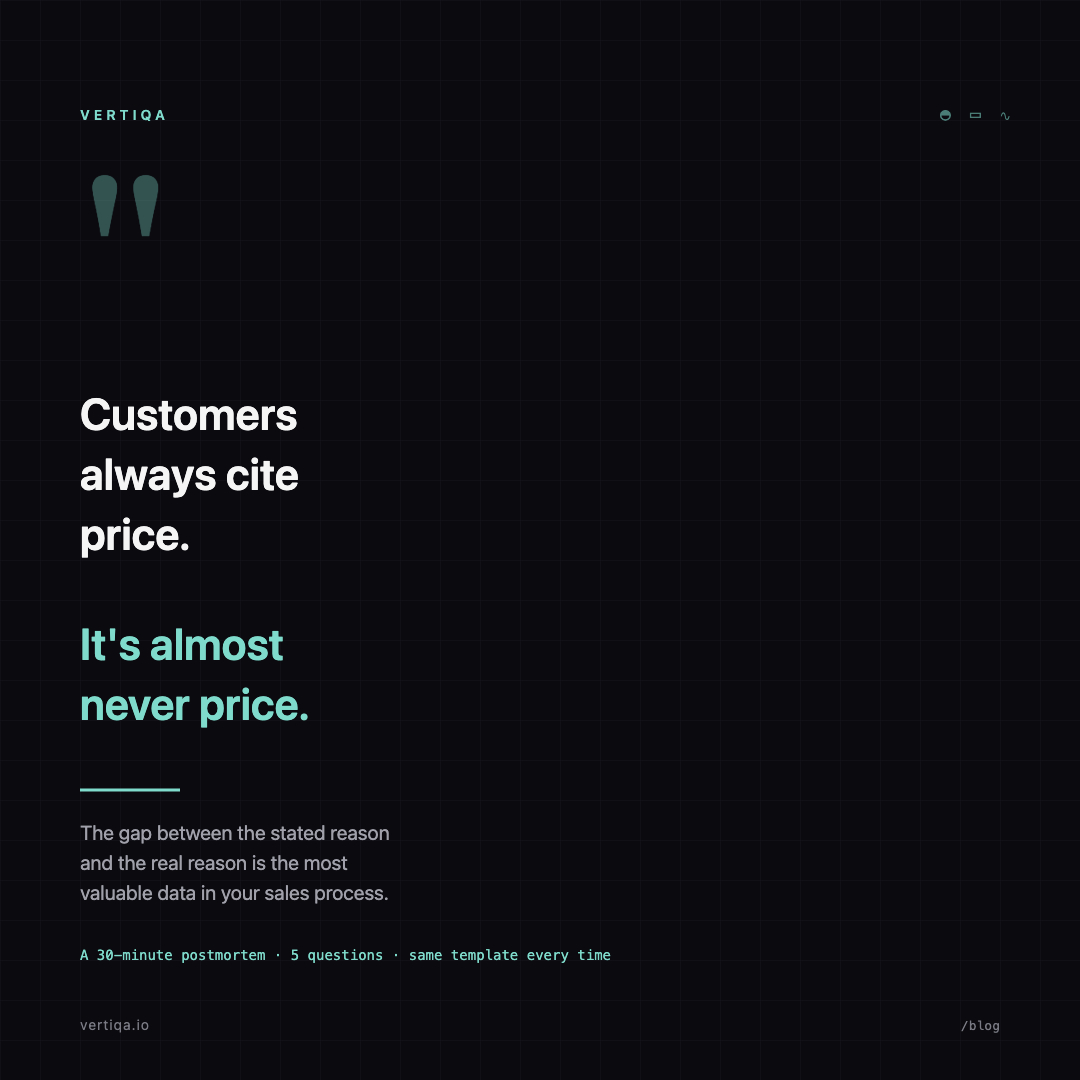
Friday afternoon. Your sales rep is sitting at their desk, eyes glazed, typing into Salesforce. Or HubSpot. Or your custom CRM. Or whatever you adopted three years ago.
The conversations of the week — the calls, the meetings, the texts, the chance hallway moments — are being translated, one keystroke at a time, into a record.
Most of what was said is being lost in translation. The rep is summarizing. They are filing details under the wrong field. They are forgetting things they said they would remember. The dropdowns are getting picked. The dashboard is going green.
By the time they leave for the weekend, the CRM looks healthy. The relationships do not.
This is the data-entry frame. It is the dominant frame in commercial software. And for a relationship-driven business, it is the wrong frame.
What "data entry" actually assumes
When you treat your CRM as a place reps go to do data entry, you are implicitly assuming three things. All three are wrong for relationship businesses.
Assumption 1: The truth lives in the rep's head, and the database is downstream of it
The rep had the conversation. The CRM did not. The rep's job is to translate what happened into the system's fields. The system catches what the rep chooses to catch.
This assumption breaks immediately under load. A rep who had eight conversations on Tuesday cannot accurately reconstruct what each one was about by Friday. Memory degrades — for everyone, including the most disciplined operator alive.
The data that lands in your CRM by end of week is not what happened. It is what the rep can still remember on Friday afternoon, filtered through what they think the manager wants to read.
Assumption 2: The structure of a record matches the structure of a relationship
A CRM record has fields. Name, company, stage, last contact, next action, owner.
A relationship has continuity, context, emotional history, prior commitments, mutual understanding, drift, recovery, and inside jokes. It has the name of the customer's daughter. It has the offhand comment in the parking lot last March. It has the price the rep almost quoted before they thought better of it.
Fields capture less than 20% of what a relationship contains. The other 80% is in the conversation — and the conversation is mostly not in the CRM.
Assumption 3: A typed entry is durable
When the rep types "follow up next week on pricing question," they create a sentence. The sentence sits in a field. The sentence is a fragment, severed from the context that produced it.
Three weeks later, when somebody reads "follow up next week on pricing question," it tells them almost nothing. Why? What pricing question? With whom? In what tone? Against what competitor? Coming off what prior conversation?
Data entry produces fragments. Memory is not fragments. Memory is connected.
What relationship businesses actually need
A relationship-driven business does not run on records. It runs on memory and follow-through.
Memory is the unified, queryable, time-aware account of every interaction with a customer, every promise made and kept, every preference discovered, every objection raised, every name dropped. It is not the same as data. Data is what fields hold. Memory is what someone who has been working a relationship for two years has in their head.
Follow-through is the discipline of acting on memory. Not as a one-off ("did I send that quote?") but as a system. Every commitment has a clock. Every clock is being watched by something. The next action is on someone's screen with the context attached, at the right moment.
These two together — memory + follow-through — are what a relationship business runs on.
CRMs were not designed to hold either. They were designed to hold records.
Data entry produces records. Records are not memory.
The architectural shift
If you accept that the right frame is memory + follow-through rather than data entry, three things change about how you build your operation.
First: capture stops being a human job
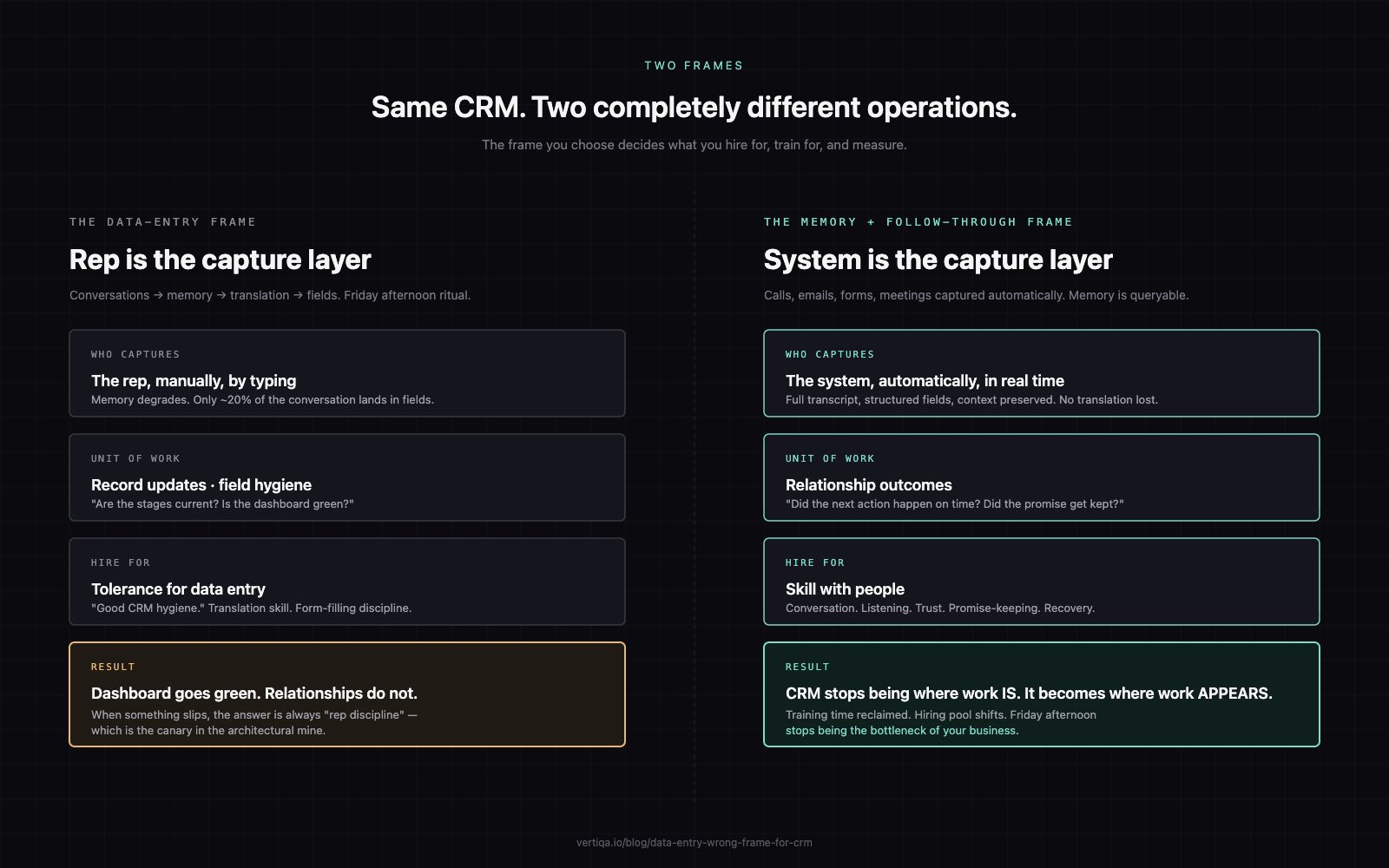
In the data-entry frame, the rep is the capture layer. They translate conversations into records.
In the memory-and-follow-through frame, capture happens automatically. The phone call gets captured — audio, transcript, structured fields — without the rep typing. The email gets captured. The form gets captured. The meeting gets captured. The text gets captured. The rep's job is to have the conversation, not to summarize it after.
This is not a minor efficiency improvement. It is a category change. When capture is automatic, the system has the truth. When capture is manual, the system has whoever-was-tired-on-Friday's filtered version of the truth.
Second: the unit of work stops being the record
In the data-entry frame, you measure rep activity by record updates. Are the fields filled in? Are the stages current? Is the dashboard green?
In the memory-and-follow-through frame, you measure rep activity by relationship outcomes. Did the next action happen on time? Did the customer feel known? Did the promise get kept?
The CRM is no longer a place to update. It becomes a substrate that the operations of the business read from, write to, and act on automatically. The dashboard stays useful for forecasting. It stops being the proxy for whether work is happening.
Third: the rep stops being the system of last resort
Most CRM failures get blamed on rep discipline. "Our reps don't update the CRM."
That sentence reveals the frame. If reps are responsible for capture, capture will fail at scale. Human discipline does not scale to multi-hundred-call weeks across teams. Anyone who has tried to enforce CRM hygiene on a busy sales team knows this in their bones.
The right architectural response is not to discipline harder. It is to make the rep not the capture layer. Move capture to the system. Free the rep to be the conversational layer — which is what you hired them for in the first place.
What this means for how you hire and train
If you have been hiring for "CRM hygiene" — the willingness and ability to keep records updated — you have been hiring for the wrong job.
The right hire for a relationship-driven business is someone who can hold a conversation, listen for the signals, build trust, make a promise, and keep it. These are different skills from data entry. They are also rarer.
The "good CRM hygiene" rep was a stopgap for an architectural failure. They were the human compensation for software that should have been capturing automatically. When you hire for that skill, you reward people for translating well — not for relating well.
Move the capture to the system, and the hiring filter changes. You are no longer screening for "people who tolerate data entry." You are screening for "people who are good with people."
That is a smaller talent pool. It is also the right one.
Training shifts in the same direction. New-rep training in most service businesses spends roughly half its time on how to use the CRM. None of that time is teaching the rep something the customer will ever notice. Move the capture to the system, and you reclaim the training time for the things that compound — discovery, listening, objection handling, recovery from a broken promise. The things customers do notice.
Why this is hard to change
The data-entry frame is sticky for reasons that are mostly not the software's fault.
It's what every sales training program teaches. Generations of sales managers grew up on the assumption that the CRM is updated by the rep. They built dashboards, comp plans, performance reviews, and meeting structures around that assumption. Changing the frame requires unbuilding all of that.
Audit and accountability incentives. Compliance, board reporting, and quarterly business reviews want a record they can point to. The record exists because someone typed it. Auditors don't yet ask for "the system's captured memory of the relationship." They ask for "the CRM report."
The software has trained the customer. Twenty years of being told that the CRM is the source of truth has made operators believe the database is the relationship. It is not. The database is one of many shadows the relationship casts.
None of these reasons is good. They are also real. Changing the frame requires changing the audit reports, the comp plans, the manager training, and the cultural assumption — not just the software.
The good news: the change pays for itself the first quarter the rep stops spending Friday afternoons translating their week.
Where we fit
We built Vertiqa to be the memory-and-follow-through layer underneath a service business. Capture across phone, inbox, calendar, forms, and chat happens automatically. Memory of every interaction lives in one queryable place. Follow-through — the clock on every commitment, the next action with context — runs as a service, not as a discipline.
We do not replace your CRM. We make your CRM stop being where the work is, and start being one of many surfaces where the work appears. The CRM stays useful for the things it was good at — pipeline state, forecasting, reporting. It stops being the place where reps spend Friday afternoon translating their week into fields.
If you want to see what that looks like: view the live demo or hear the AI receptionist live at (678) 716-4200 — 90 seconds, no signup.
The short version
Treating CRM as data entry assumes the rep is the capture layer. They are not, at scale.
The right frame is memory and follow-through, both held by the system, both operating without depending on Friday-afternoon discipline.
If your reps are complaining about CRM data entry, the complaint is not about discipline. It is the canary in the architectural mine. Listen to it.
The first move is to stop training reps to type. The second is to put a layer underneath the CRM that captures automatically, holds the memory, and watches the clock. The third is to hire differently.
The reps will tell you the truth about the frame. Most owners have stopped listening because the answer is uncomfortable. The answer is: you are paying expensive human attention for cheap software work. The fix is structural, not cultural.
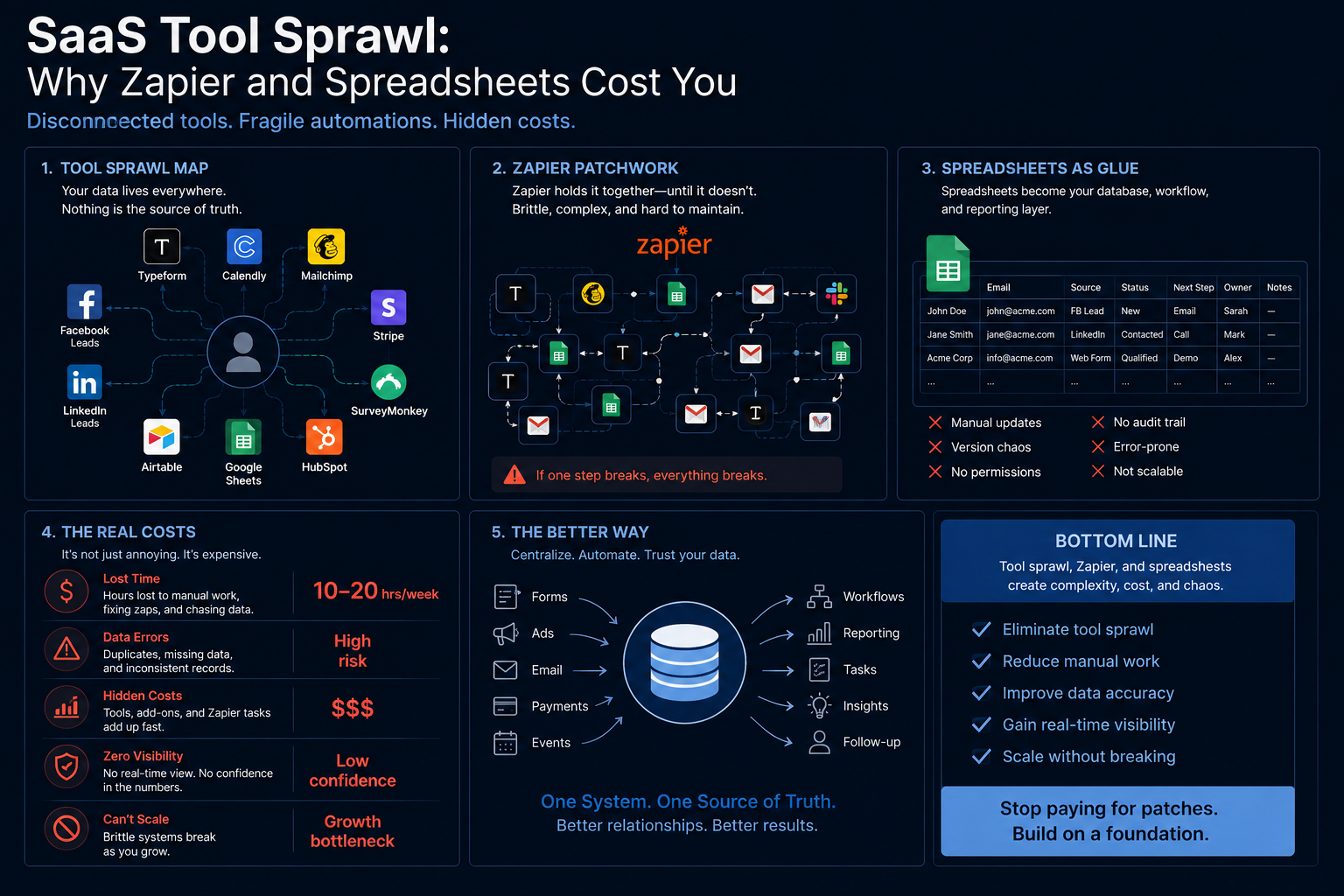
Related posts in this series:
Your CRM isn't broken. Your follow-through is. — the entry-level manifesto.
A dozen apps. No driver. — the architectural diagnosis.
The hidden cost of every tool you add. — what the data-entry tax actually costs in dollars.
The first 10 minutes of an inquiry call. — what reps should be doing instead of typing.
— The team building Vertiqa Atlanta