Your director of ops just signed off on a new tool. It's $14,400 a year. The team needs it. The case is clear. The procurement form is one click away.
What that form doesn't capture is the other number — the one nobody on the email thread has calculated. The cost of the new tool isn't $14,400. The cost of the new tool is $14,400 plus the additional time every employee who touches it will lose to context-switching, plus the cognitive recalibration tax on every workflow it intersects, plus the small but real degradation in response time across the team it integrates with.
For most mid-sized operations teams, the hidden cost is two to four times the sticker cost. Sometimes more.
This post shows you how to actually calculate that hidden cost — for a single role, for a team, for your whole org — using nothing but the Harvard Business Review's 2022 toggle-tax study and your own payroll spreadsheet. We'll walk through the math, give you the audit, and at the end show you the discipline that consolidates the stack instead of growing it.
If you've never seen these numbers in dollar terms, the result will surprise you.
The sticker price and the true price
Every tool has two prices. The first is on the invoice. The second is on your P&L, paid in employee time, but never explicitly attributed.
The invoice is what your finance team sees. It is also the smaller number.
The hidden price is the cost of context-switching. The cost of a worker stopping a task in Tool A to deal with a notification from Tool B, then taking 11 seconds to remember what they were doing in Tool A. The cost of the rep who needs to assemble customer history across six dashboards before responding to a hand-raise. The cost of the manager who pings their report on Slack to ask a question already answered in a tool the manager doesn't open often enough to remember exists.
You don't see these costs in any line item. You see them in slower response times, in missed renewals, in the strange feeling that your team is busier than ever and shipping less than they used to.
The HBR study put a number on it. Now we'll put a dollar sign in front of the number.
The HBR baseline, restated for finance
In August 2022, researchers tracked 20 teams (137 users) at three Fortune 500 companies for up to five weeks, measuring how often workers switched between applications and what it cost. The headline findings are now well-known. They are also stunningly under-priced.
Metric | HBR finding |
|---|---|
Application/tab switches per day | 1,200 per worker |
Time per week spent reorienting | ~4 hours per worker |
Share of total annual work time | 9% |
Share of switches followed by another within 11 seconds | 65% |
Aggregate cost at a 10,000-person company | ~80,000 hours per week |
For our purposes, the number that matters is 9%. Nine percent of an employee's total annual time at work is consumed by context-switching. Not deep work. Not collaboration. Pure reorientation tax.
Treat that 9% like you would any other unaccounted-for cost line. Multiply it against fully-loaded compensation.
How to turn 9% into dollars
Step one: take an employee's fully-loaded annual cost. That's salary × a loading factor that covers payroll tax, benefits, equipment, software, and overhead. For most US companies that factor sits between 1.25 and 1.4. Use 1.3 if you don't have a more specific number from finance.
So a CSM with an $85,000 base salary has a fully-loaded annual cost of roughly $110,500.
Step two: multiply by 9%.
That CSM's annual toggle tax is $9,945.
That's the cost — already, with the stack they have today — of context-switching. Not their salary. Not their benefits. The fraction of their fully-loaded cost the company pays them while they're reorienting from one tool to the next.
Now do this for your whole team. Let's say you have:
4 customer success managers @ $85K base ($110.5K loaded)
6 SDRs @ $60K base ($78K loaded)
3 account executives @ $130K base ($169K loaded)
2 operations analysts @ $90K base ($117K loaded)
Annual toggle tax across this 15-person team:
(4 × $110,500 + 6 × $78,000 + 3 × $169,000 + 2 × $117,000) × 9% = ($442,000 + $468,000 + $507,000 + $234,000) × 9% = $1,651,000 × 9% = $148,590 per year
That's almost $150,000 a year that this team pays — invisibly, off-ledger — to reorient between tools. It is more than the all-in cost of an additional headcount. It is more than most teams spend on their entire SaaS stack.
And this is the baseline. This is what they're paying today, before you add a single new tool.
What every additional tool costs
The HBR study didn't break the 1,200-toggle baseline down by tool count, so we can't tell you "tool #9 costs X% more toggles than tool #8" with peer-reviewed precision. But the directional logic is unambiguous.
Every tool that touches a workflow does three things:
It generates notifications, alerts, and emails that demand attention switching.
It holds context the worker now has to retrieve when working in other tools.
It creates a new tab, login, and mental model in the worker's daily orbit.
None of those costs were in the baseline 9%. The baseline measured a stack that already existed. New tools add new toggle activity on top of the baseline — and the cleanest way to plan for them is to assume each new tool that touches a regular workflow adds an additional small percentage of context-switching cost across the team that touches it.
A practical planning rule: when evaluating a new tool, calculate not just its subscription cost but also the expected hidden cost as (team-touching-the-tool × loaded comp × 2-5%). Then ask whether the tool's measurable productivity benefit exceeds that combined number.
For the 15-person team above, even a modest 3% additional toggle cost adds ~$50,000 a year to the true cost of the tool. That's $50K nobody is going to put on the procurement form.
Most of the time, it's enough to flip a "yes" into a "no."
A four-step audit you can run this week
You don't need a consultant for this. You need an afternoon and the spreadsheet linked at the end of this post.
Step 1 — Pull the headcount and compensation table
Take the team you want to measure (could be ops, sales, customer success, or your whole company). For each role, get the base salary. If you can get the fully-loaded cost from finance, use it. Otherwise multiply by 1.3.
Sum the column. That's your fully-loaded team cost.
Step 2 — Apply the HBR factor
Multiply your fully-loaded team cost by 9%. That's the baseline toggle tax — what the team's current stack is costing you in context-switching today.
You may want to apply a smaller factor (5-7%) for roles whose work is naturally single-app heavy (e.g., engineers in deep IDE work) or a larger factor (12-15%) for roles whose work spans many tools (e.g., account executives, ops managers, customer success). Adjust by role, then resum.
Step 3 — Count the tools, divide
Count the distinct software tools (apps + frequently-visited internal web tools) the team interacts with in a typical week. Most operations teams are between 8 and 25.
Divide your toggle tax by the tool count. That's the implied toggle cost per tool.
For our 15-person team with a $148K toggle tax and 14 tools, the implied per-tool toggle cost is $10,613 per year. Per tool. On top of subscription.
This number lets you flip the question: when someone says "tool X only costs $4,800/yr," you can ask "is its productivity benefit worth more than $4,800 plus $10,613?"
Often the answer is no.
Step 4 — Compare to your SaaS subscription spend
Pull your total annual SaaS subscription spend for the team in question. Most ops leaders are surprised to find their toggle tax is 1.5x to 4x their subscription spend.
If your subscription spend is $40K/yr and your toggle tax is $150K/yr, you're not running a $40K stack. You're running a $190K stack. That changes how every future tool decision should be evaluated.
What "the integration will fix it" gets wrong
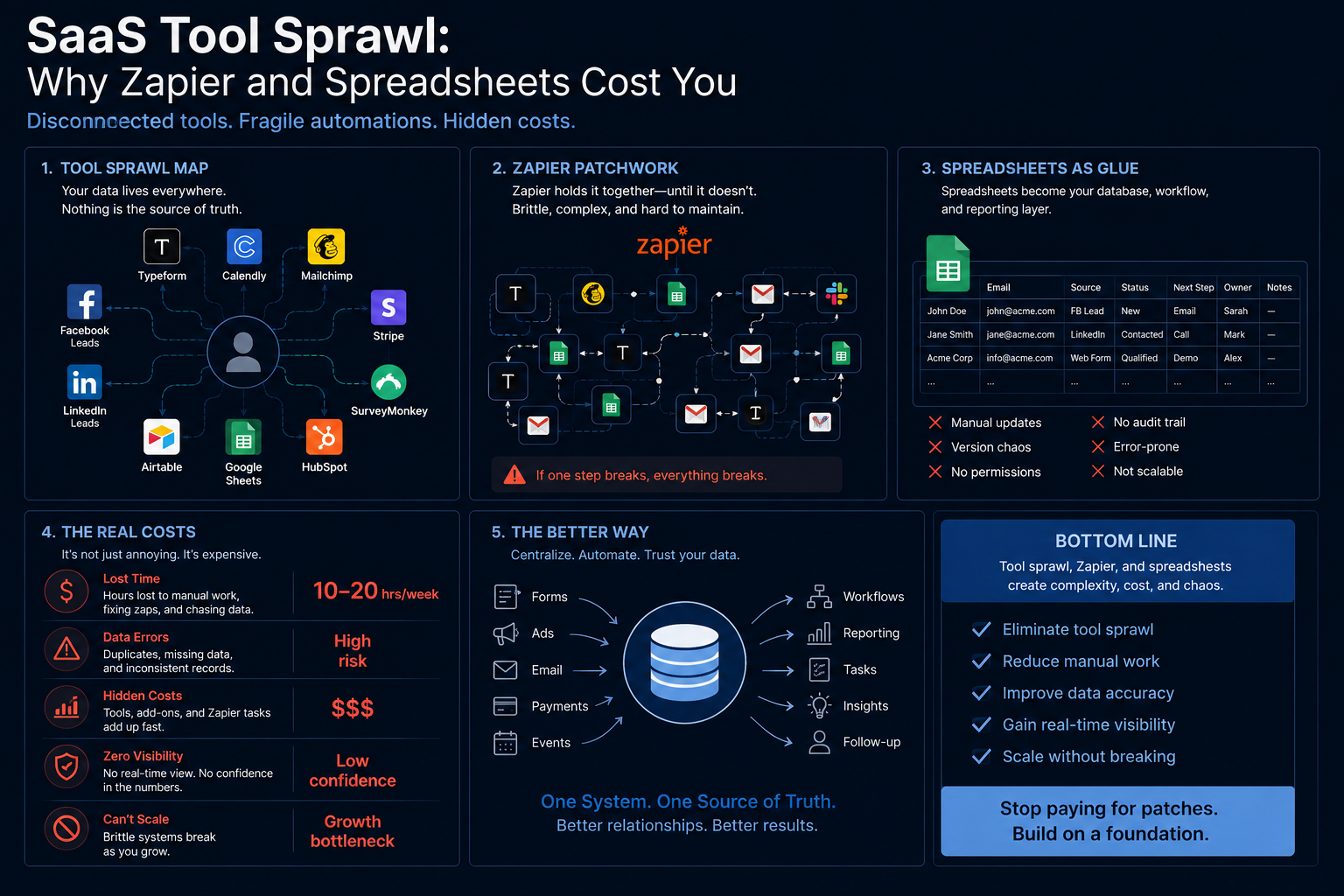
The most common objection to this math: "Sure, but we have Zapier / iPaaS / Workato — the tools are connected, so switching cost is lower."
Integration helps. It does not eliminate the toggle tax. Three reasons:
Data flowing into a tool doesn't reduce the toggle activity of that tool. Salesforce updating a Slack channel still produces a Slack notification that yanks the worker's attention.
Worker context lives in the worker's head, not in the data layer. When the CSM moves from QBR prep in Notion to logging a renewal note in your CRM, the integration carries the data. It does not carry the cognitive frame. The worker still pays the 11-second recalibration cost.
Adding integrations adds tools. iPaaS platforms have their own admin surface, their own monitoring, their own troubleshooting. They are real tools added to the stack, with real toggle cost of their own.
Integrations are valuable. They are not a cure.
What actually reduces the toggle tax
Three things actually move this number. None of them are "add a better Zapier."
1. Consolidate ruthlessly
The most underused operating discipline in software-procurement is "for every new tool added, retire one." It is shockingly hard to enforce. It is also the single highest-leverage policy a CIO or COO can set. Most teams accrete tools the way attic boxes accrete junk — slowly, individually justifiable, collectively suffocating.
A target worth setting: every team should be able to list the tools its work depends on weekly, and the list should be under ten. If you can't get under ten, you have a structural problem, not a tool selection problem.
2. Move to operating layers, not point solutions
A point solution adds one capability and one toggle. An operating layer absorbs multiple capabilities and removes toggles. The economics flip: the operating layer's value isn't just what it does, it's what it lets you turn off.
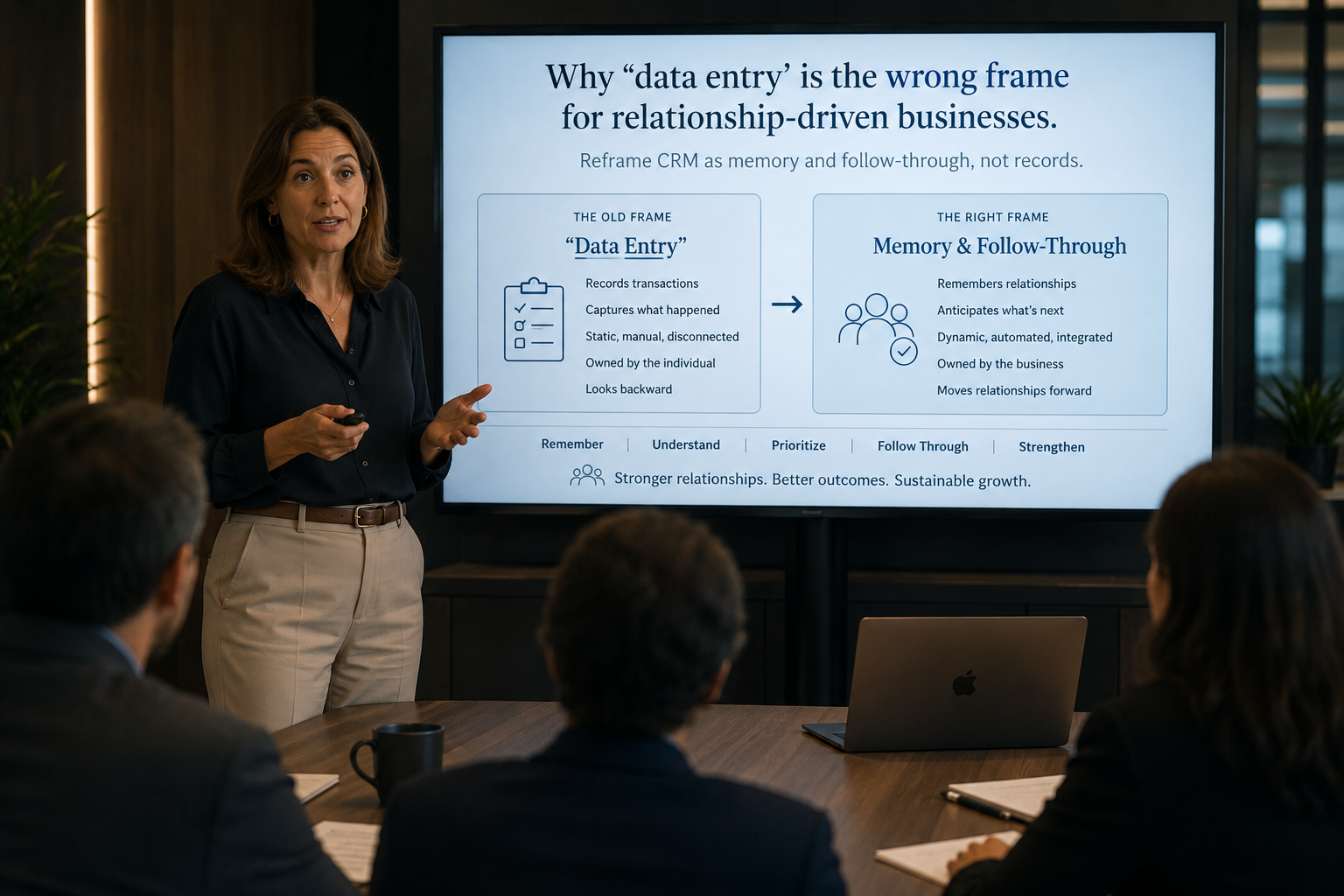
This is the case Vertiqa makes for itself — that the right architectural shift for a service business is to consolidate phone, inbox, calendar, portal, pipeline, follow-up, and tasks into one memory and one next-action queue, so that the operator's day isn't a tour of seven tabs. We have an obvious bias. Even with the bias, the math is on the side of operating layers for any team where roles span the customer relationship end-to-end.
3. Audit by role, not by tool
Tool-by-tool audits measure the wrong thing. Role-by-role audits ("what does a CSM open in a week?") expose where the toggling actually happens and where it can be eliminated. Most consolidation projects fail because they're driven by procurement looking at tool lists. The successful ones are driven by ops looking at workflows.
The honest summary
The HBR study has been around since 2022. The math has been there to do for almost four years. Almost no operations team has done it.
You can do it this week. The numbers will not flatter your stack.
When you have them, two changes follow naturally. First, the bar for adding new tools goes up — because for the first time, you can actually see what they cost. Second, the case for consolidation gets stronger every month, because the toggle tax keeps compounding while the subscription line item stays flat.
The cost of every tool you add is real. The cost of every tool you keep is real. Most of it is invisible. None of it has to stay that way.
Run the calculator on your own team: download the Toggle Tax Calculator — drops in your headcount, comp, tool count, and SaaS spend, and tells you the real cost of your stack.
Other Vertiqa posts in this series:
Your CRM isn't broken. Your follow-through is. — the manifesto.
Speed-to-lead is the whole game. Almost nobody plays. — where the toggle tax meets the missed-lead leak.
How many leads is your voicemail actually eating? — the 30-day audit.
See the operating layer side: view the live Vertiqa demo.
Sources
Harvard Business Review — Rohrer, J. & Rieger, A. (August 2022). "How Much Time and Energy Do We Waste Toggling Between Applications?" 20 teams, 137 users, three Fortune 500 companies.
Fully-loaded employee cost multiplier (1.25-1.4×) is a standard finance/HR planning convention covering payroll tax, benefits, workspace, equipment, and overhead. Confirm your organization's specific multiplier with finance before reporting numbers externally.