It's 7:51 PM on a Tuesday. A homeowner whose furnace just gave out picks up the phone and dials the first HVAC company that comes up in her search. It rings. It goes to voicemail. She doesn't leave one. She taps back to her search and calls the next number.
It's 9:14 AM on a Wednesday. A buyer at a mid-sized manufacturer fills out a contact form on a vendor's website. The form lands in a shared inbox. A sales rep is the right person to respond. He does — 47 hours later. By then the buyer has talked to three competitors and signed a letter of intent with one of them.
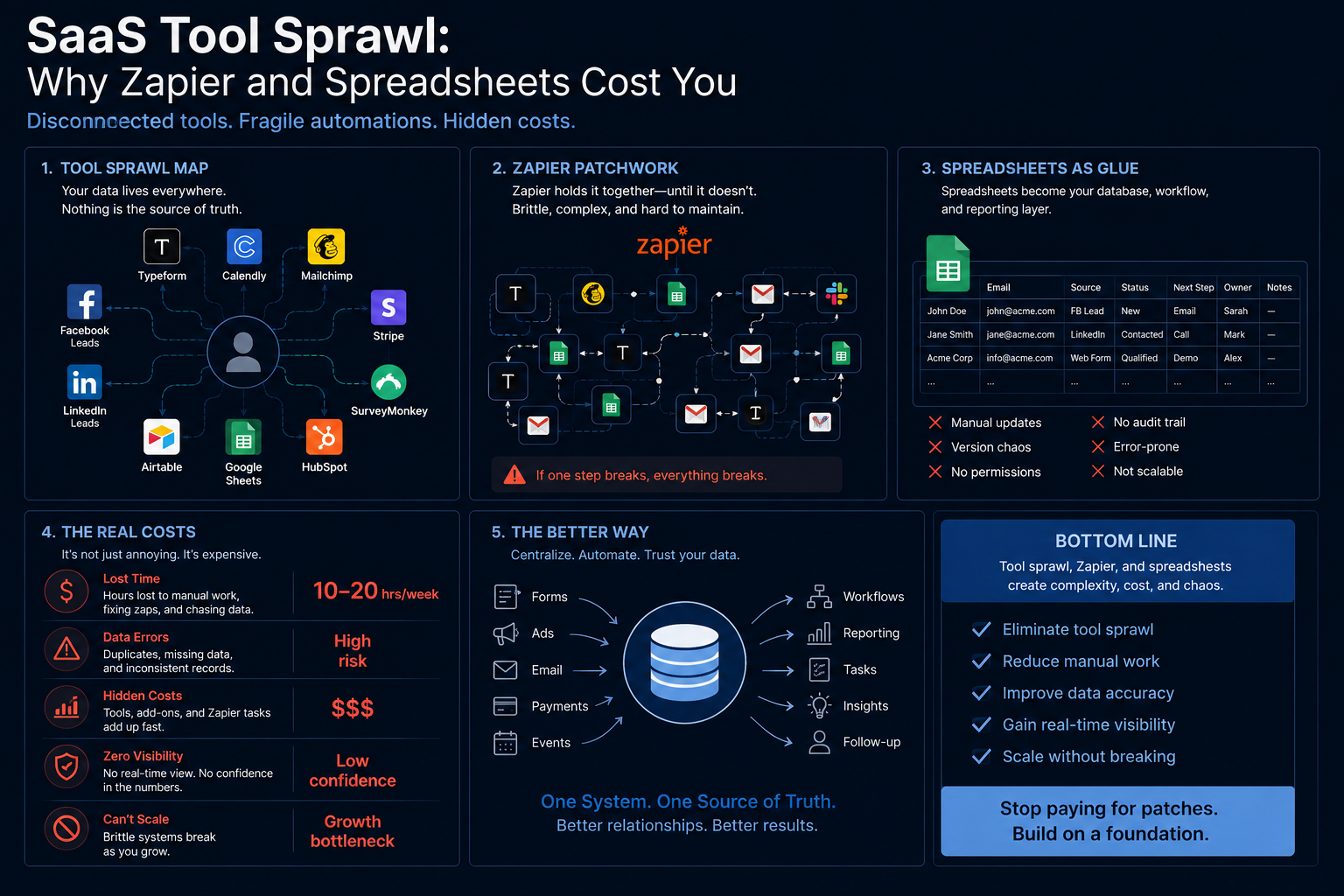
It's 2:30 PM on a Thursday. The sales rep who would have responded faster has bounced between his CRM, his inbox, his calendar, a quoting tool, a Slack channel, and a project tracker 47 times in the last hour. By the time he gets back to the form submission, it's already cold.
Three different scenes. Three different losses. One underlying problem.
We have decades of research saying that the business that responds first wins. We have decades of research saying that almost no business actually does.
This post pulls together the three threads — missed inbound calls, slow lead response, and internal context-switching friction — and argues that they are not three separate problems. They are one problem, wearing three faces. We'll show you the numbers, then show you what actually fixes it.
The 5-minute rule (and the 47-hour reality)
In the early 2000s, Dr. James Oldroyd at MIT analyzed roughly 15,000 sales leads to figure out how response time affects outcomes. The conclusions were so stark they're now industry canon — and most businesses still don't act on them.
A sales rep who attempts contact within 5 minutes of an inbound inquiry is:
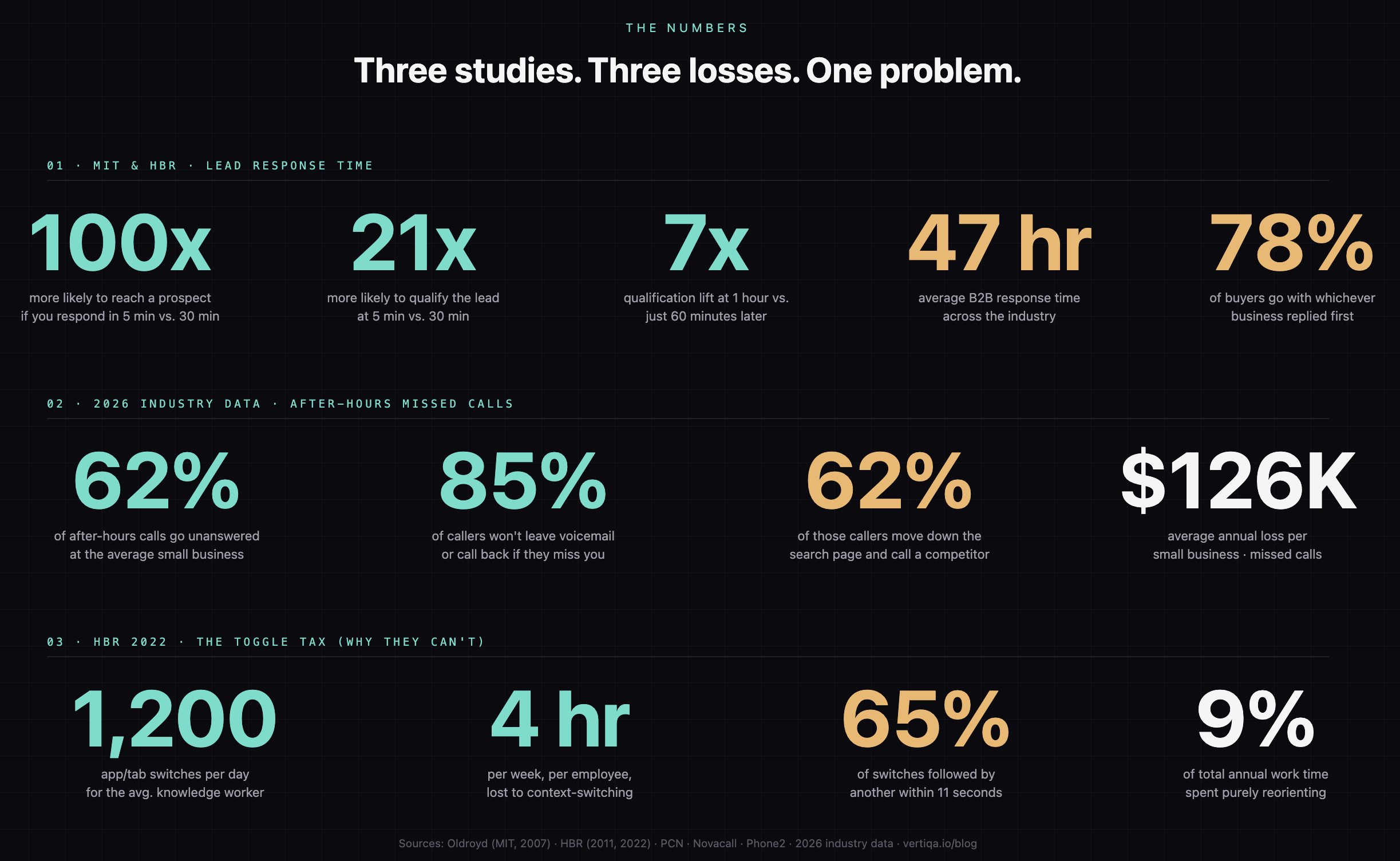
100x more likely to reach the prospect than a rep who waits 30 minutes
21x more likely to qualify them as a viable opportunity
A complementary Harvard Business Review study (Oldroyd, McElheran, & Elkington) looked at 2,241 companies and found that reaching out within 1 hour makes a rep 7x more likely to have a meaningful qualification conversation than waiting just one hour longer.
After 24 hours, qualification odds collapse by more than 60x.
So what does the average business do?
The industry-wide average B2B response time is 47 hours. Nearly two days. By the time the average rep replies to a hand-raise, the prospect has already finished their evaluation. A separate 2026 analysis found that 78% of buyers purchase from the first business to reply — which means the average company forfeits roughly four out of five inbound opportunities to whichever competitor was faster.
The bar is 5 minutes. The reality is 47 hours. The penalty is most of the business.
It is hard to overstate how unusual this gap is. There is no other category of operational discipline where the right answer has been this well-documented for this long and almost universally ignored. Imagine if 20% close rates were the proven ceiling and most businesses settled for 0.5%. That is roughly where speed-to-lead sits.
The after-hours blindspot
The lead-response data above is from B2B. The picture in service-business inbound — where the inquiry channel is more often a phone call than a form — is, if anything, worse.
According to the 2026 Small Business Missed Call Revenue Study, even a conservative 30 missed calls per month exposes high-value service sectors to $25,000–$75,000 in annual revenue leakage. Aggregated 2026 industry data via AInora and GetAira estimates the average total loss at $126,000 annually per small business.
The killer slice is after-hours. A Novacall AI study found that small businesses miss an average of 62% of inbound calls that arrive outside standard business hours — and that this window represents 38% to 47% of total inbound consumer demand. Annualized across the U.S., that's roughly $81.2 billion in lost revenue.
What happens to those calls? Call-tracking data from Phone2 is unsentimental: 85% of callers will not call back or leave a voicemail if they don't reach a person on the first attempt. 62% of them immediately call a competitor instead.
The damage isn't evenly distributed. According to Ambs Call Center, the verticals with the highest revenue-loss multipliers — large contract sizes, high customer lifetime value — also have some of the highest miss rates:
Home services: 40-60% of inbound calls missed
Legal services: ~35% missed
Healthcare: ~34% missed
These are the businesses that least can afford a missed call, missing the most of them.
Combine the two findings: prospects are calling when you're closed (38-47% of demand), most of those calls go to voicemail (62%), most of those callers never call back (85%), and most of those who don't call back call your competitor in the next 60 seconds (62%).
That isn't a leak. That's a tap left running.
The toggle tax (the leak from the inside)
So why don't businesses just fix this? Hire more reps. Buy more software. Be faster.
This is where the third study comes in — and where the picture starts to make sense.
In August 2022, the Harvard Business Review published a study of 20 teams comprising 137 users at three Fortune 500 companies, tracked for up to five weeks. The researchers measured how much time knowledge workers spend simply switching between applications. The number is staggering:
The average knowledge worker toggles between applications and websites 1,200 times per day.
Each switch requires a brief cognitive recalibration.
The total cost is roughly 4 hours per week per employee spent purely on reorienting.
That's 9% of an employee's total annual time at work — just on switching.
At a 10,000-person organization, 80,000 hours of labor per week disappear into the gap between tabs.
And here is the line that should stop every operations leader cold: after 65% of app switches, the user toggles to another app less than 11 seconds later.
Workers aren't switching apps to focus. They're switching apps because the previous app didn't have what they needed and the next one might. Their attention is fragmented at the 10-second granularity. Their cortisol levels are elevated. Their exhaustion is systemic.
This is the inside half of the speed-to-lead problem. The reason your reps can't respond to a hand-raise in 5 minutes isn't that they don't want to. It's that the work of responding — find the CRM record, check the calendar, draft the email, look up the price, pull the customer history, log the action, schedule the follow-up — is spread across six tools, three logins, and at least one Slack DM to a coworker. By the time the rep has assembled the context to actually respond, the lead is 47 hours old and the buyer is gone.
The toggle tax and the missed-lead leak are the same problem. The toggle tax is what it feels like inside; the missed lead is what it costs outside.
Why "be faster" doesn't work
When operations leaders see the speed-to-lead data, the instinct is to add pressure: enforce a 5-minute SLA, build a dashboard, name and shame the slow responders.
This almost never works. Here's why:
Pressure without infrastructure produces guilt, not speed. If the rep needs 12 minutes of context-assembly to respond well, a 5-minute SLA just means responses that are fast and bad. Customers don't reward fast-and-bad.
Hiring more reps is not the bottleneck for most businesses. The reps you have are already over-scheduled. Buying their attention back from app-switching is cheaper and faster than adding headcount.
Routing rules don't solve missed calls. Better round-robin assignment doesn't help if the call rings at 9 PM and nobody is there. The fix has to be a system that captures the call, not a rule that picks who would have answered it.
Answering services and outsourced receptionists are strictly better voicemail. They take a message. They don't move the deal forward. They don't reduce the time-to-meaningful-response that the buyer experiences.
The actual fix has to do three things at once:
Capture the inbound in real time — call, form, message, after-hours, weekend, whenever.
Assemble the context for the rep automatically — customer record, history, pipeline stage, prior conversations — so the rep doesn't have to toggle into six tools to start.
Land the next action on the right person's screen — with the context already attached — so the response time is measured in minutes, not hours.
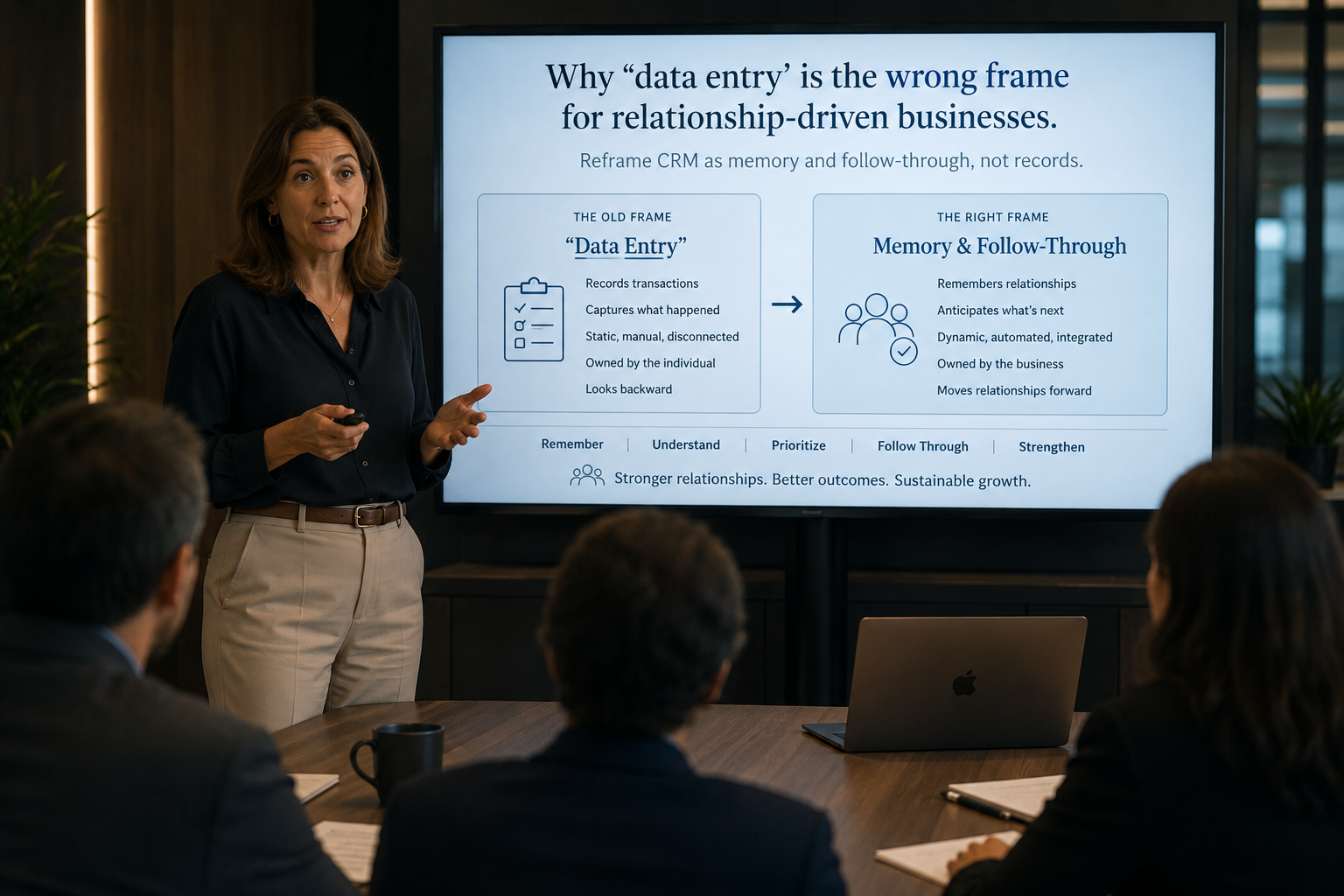
That is not a CRM. It isn't a Zapier flow. It isn't a chatbot. It's an operating layer that sits across the channels, holds the memory, and decides what should happen next.
This is what we built Vertiqa for. We aren't going to pretend we are the only solution — there are real answering services, real CRMs, and real sales-engagement tools that solve parts of this. But the math in this post does not get fixed by parts. It gets fixed by a layer.
What you can actually do this week
Even if you never look at Vertiqa, the three studies in this post have three corresponding actions you can take in the next seven days. Each one is cheap. Each one will tell you something true.
1. Calculate your specific missed-call leak
The voicemail audit we published last month is a 30-day, no-software, free audit you can run yourself. It produces four numbers and one dollar figure: how much pipeline you are losing right now. Most owners are off by 20-40%. Find out which way.
2. Measure your real lead response time
Pull the last 30 inbound form fills, emails, and calls. For each, record the timestamp of inquiry and the timestamp of the first meaningful reply (not "got it, will look soon" — actual answer). Calculate the median. Compare to 5 minutes, 1 hour, 47 hours. If your number is above 1 hour for any meaningful share of inbound, you have a fixable problem that will pay for the fix in weeks, not quarters.
3. Audit your team's toggle count
Pick two reps. Ask them to count, for one workday, how many distinct apps and tabs they switched into. They'll be off by half — researchers find people guess about 50% of their actual toggle count. The exercise itself surfaces the dependency map: which tools live where, and where the friction is concentrated.
You'll know in a week whether you have a 5-tool stack or a 15-tool stack. The 5-tool stack you can probably tune. The 15-tool stack needs a different shape.
The honest summary
Three studies, decades apart, in different parts of the operations stack, all point to the same conclusion. Speed-to-lead is the strongest predictor of revenue you have access to. Almost no business is running on it. The reason isn't that owners don't care — it's that the standard tooling makes it physically impossible to respond in 5 minutes, capture an after-hours call, and not lose four hours a week to context-switching all at once.
You can paper over one of those problems. You can't paper over all three.
The businesses that figure this out — that build a real follow-through layer across phone, email, form, and calendar, with shared memory and automatic next-action routing — will compound their advantage quietly for a few years. The businesses that don't will keep wondering why their close rate is fine but their pipeline keeps thinning.
The math is settled. The question is what you do about it.
If you want to see the operating layer side of this: view the live Vertiqa demo or hear the AI receptionist live at (678) 716-4200 — 90 seconds, no signup.
Three quick reads we'd recommend next:
Your CRM isn't broken. Your follow-through is. — the manifesto behind this post.
How many leads is your voicemail actually eating? — the free 30-day audit.
Sources
MIT / InsideSales lead-response benchmark — Oldroyd, J. (2007). Analysis of 15,000 sales leads.
Harvard Business Review — Oldroyd, McElheran, & Elkington, "The Short Life of Online Sales Leads" (March 2011). Analysis of 2,241 companies.
Harvard Business Review — "How Much Time and Energy Do We Waste Toggling Between Applications?" (August 2022). 20 teams, 137 users, three Fortune 500 companies.
AInora — "Lead Response Time Statistics — Every Study, 2026."
GetAira — "Missed Business Calls Statistics."
Novacall AI — "Missed Call Statistics for Small Business by Industry, 2026."
Phone2 — "The True Cost of Missed Calls."
Ambs Call Center — "The Cost of a Missed Call."
CalleadsAI — "Lead Response Time Statistics 2026."