A prospect calls. Your phone rings. You answer.
What happens in the next ten minutes decides almost everything that follows. Whether this person becomes a customer. Whether they tell their neighbor about you. Whether the lead lives in your CRM as "warm" or "cold" by Friday. Whether the rep three desks over picks up the thread next month with the context they need to close.
It is the most leveraged ten minutes in your business. It is also the most under-rehearsed.
The shops that win are not the shops with the best CRM, the most polished website, or the lowest price. They are the shops where whoever picks up the phone runs a tight, deliberate first ten minutes — every time, even at 9 PM, even on a Friday, even when they're tired. Because the call doesn't care that the rep is tired. The call is happening once.
This is the playbook. A minute-by-minute breakdown, the seven things you must capture, the scripts that work, and a five-minute post-call ritual that compounds across every relationship the call seeds.
Print it. Tape it next to the phone. Or download the one-page capture sheet at the end.
Why this is the most expensive ten minutes you have
A first inquiry call is not a sales call. It is the input event that the rest of your follow-through system runs on.
Get it right and you have:
A captured contact with verified channel info
A clear understanding of intent in the prospect's own words
The qualification signal you need to route the deal correctly
A booked next step
A record in your CRM that the next rep, the next manager, or your future self can pick up cold
Get it wrong and you have:
A name and a phone number you'll never remember why you wrote down
A vague sense of "they were interested" that won't survive a week
An unbooked follow-up that becomes a 47-hour response delay
A prospect who has already moved on by the time you call back
The asymmetry is brutal. The first call is roughly 1% of the total relationship effort and roughly 60% of the outcome. The rest of your stack — CRM, follow-up sequences, quote tools, dispatch software — is downstream of whatever this person told you in minutes 0 through 10.
You can't fix a bad first call later. You can only run more first calls and try again.
The 7-point capture checklist (what to walk away with)
Before we get to the minute-by-minute, here is the data you must leave the call with. Every item. Every call. No exceptions.
# | What | Why |
|---|---|---|
1 | Caller's name (spelled correctly) and best callback number | Self-evident. Verify the number by reading it back. |
2 | Email address | Not optional. Required to send anything in writing. |
3 | Service address or location | For most service businesses, the address determines who handles it, who's nearest, and what rates apply. |
4 | The actual problem, in their words | Not your interpretation. Their words. The phrase "she said her unit hasn't worked since last Tuesday" is more useful than "service request — heating." |
5 | When the problem started, what they've tried | Tells you urgency, severity, and what conversations have already happened. |
6 | How they found you | First-touch attribution is the single most underused number in service-business marketing. Capture it on every call. |
7 | The agreed next step, with a specific time | "I'll send a quote" is not a next step. "I'll send the quote by 6 PM today" is. |
If you leave the call without all seven, you have not run a complete first call. Anything missing has to come back through email or a callback, which costs you time and bleeds urgency.
The printable First-Call Capture Sheet at the end of this post is built around these seven. Use it for 30 days and your conversion rate goes up before you change anything else.
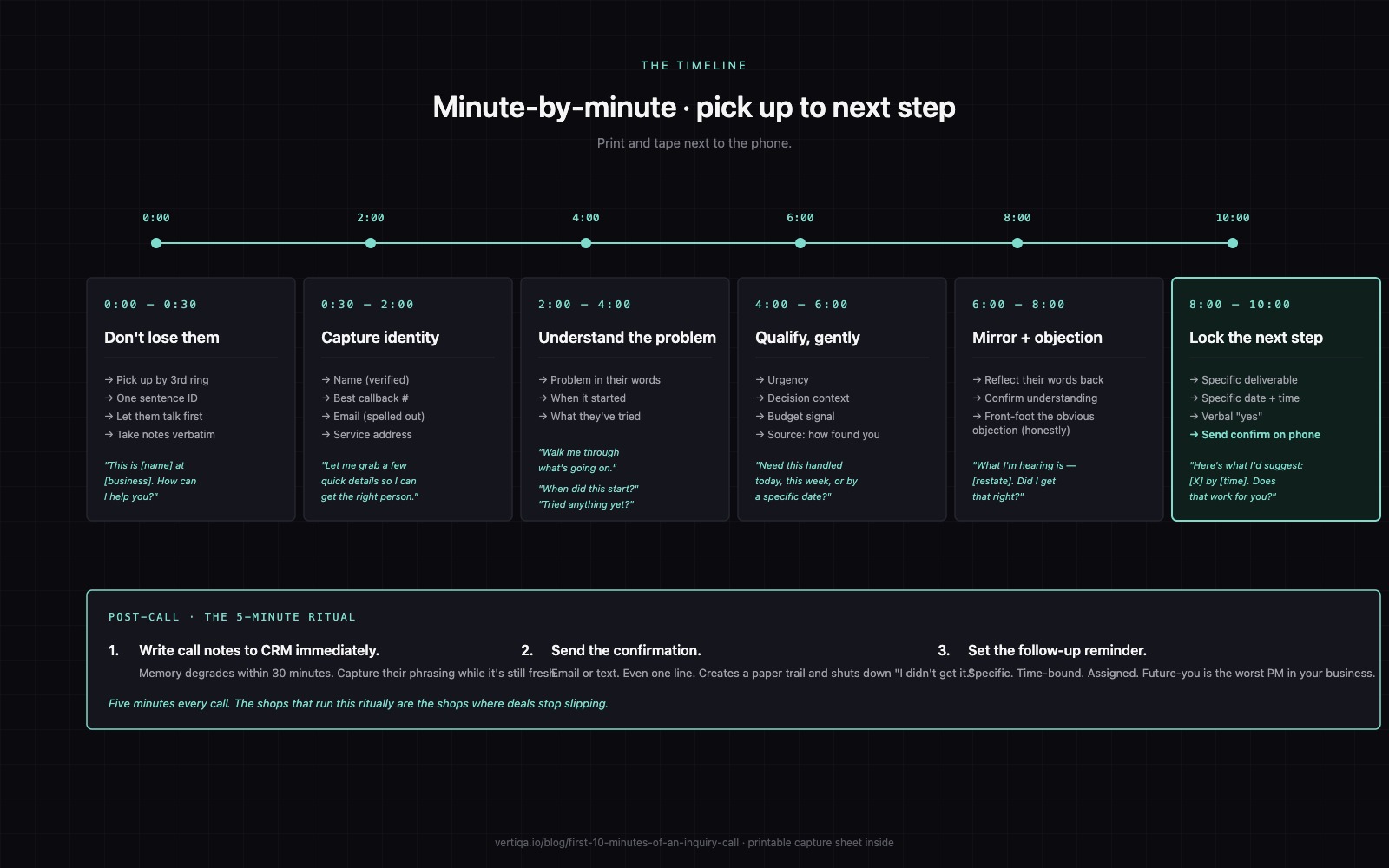
The minute-by-minute playbook
Below is the structure. Adapt the language to your vertical and your voice. The structure does not change.
Minutes 0:00 – 0:30 — Don't lose them
The first thirty seconds is the only part of the call the prospect remembers in detail. It also has the highest abandonment rate of any moment in the call.
Three rules:
Pick up by the third ring. Statistically, callers who wait past four rings are already deciding whether to hang up.
Identify yourself, the business, and the offer to help — in one sentence. Not three. Not a recorded greeting. A real voice. The script:
"Good morning, this is [first name] at [business name]. How can I help you?"
That's it. Don't add "thanks for calling," don't ask how their day is going, don't read a six-line script. The prospect did not call to be sold to in the first five seconds. They called because something is going on, and they want to know if you're going to help.
Let them talk first. Whatever they say next is your gold. Do not interrupt. Let them get out the first 20-40 seconds of context in their own words. Take notes.
The single most common mistake in the first minute: the rep asks "and what's your name?" before the prospect has finished saying why they called. Wait. They will tell you. If they don't, you ask in minute 1.
Minutes 0:30 – 2:00 — Capture identity and channel context
Once the prospect has stated their reason for calling, you transition into capture. Smoothly. The script:
"Got it — let me grab a few quick details so I can get the right person on this. Can I get your name and the best callback number?"
This is the moment to capture items 1 and 2 from the checklist. Read the number back. Spell the name. Confirm the email — say it out loud: "is that c-h-r-i-s, dot, last name, at gmail-dot-com?" People mis-hear emails constantly.
For service businesses with a location-routing need, ask for the service address now, not later. The address is the routing decision.
Do not — repeat, do not — start qualifying yet. The prospect is still in "explaining the situation" mode. Pushing into qualification questions before they feel heard makes you sound like a call center.
Minutes 2:00 – 4:00 — Understand the actual problem
This is the section most reps skip. They jump from "got it, what's the address?" to "great, I can get you a quote." They lose the deal in the gap.
What you're doing in these two minutes: getting the prospect to describe the problem in detail and in their own language. Three open questions, in order:
"Walk me through what's going on."
"When did this start?"
"Have you tried anything yet?"
Take notes. Use their phrasing. The phrase the prospect uses to describe the problem is the phrase they will use when they tell their neighbor about you, the phrase you will use in your follow-up email, and the phrase the tech or advisor on your team will hear from them again at the in-person visit.
Vertical-specific examples:
HVAC: "Walk me through what's going on" → "When did it stop heating?" → "Have you checked the thermostat / breaker / filter?"
Life insurance: "Walk me through what's going on" → "Has something changed recently — a baby, a marriage, a new home?" → "Have you talked to anyone else about coverage yet?"
Senior living advisor: "Walk me through what's going on" → "When did you first start thinking about this for your mom / dad?" → "Have you toured anywhere yet?"
Equipment financing: "Walk me through what you're trying to acquire" → "Where are you in the buying process?" → "Have you applied for financing anywhere else?"
These three questions, asked in any vertical, produce more useful qualification data than ten rounds of "what's your budget?"
Minutes 4:00 – 6:00 — Qualify (without making it feel like qualification)
Now the prospect feels heard. You have the problem in their words. You can move into the questions you actually need answered to route the deal.
Cover three things:
Urgency. "Is this something you need handled today / this week / by a specific date?" Sometimes you'll get "yesterday." Sometimes "in the next month or so." Both are useful. Write down the answer.
Decision context. "Are you the right person to make this decision, or is there someone else you'd want me to loop in?" Phrased this way, it doesn't sound like you're testing them — it sounds like you're being respectful of their time.
Budget signal (if appropriate). This depends on vertical. For HVAC service calls, you usually skip it. For installs, you ask: "Do you have a sense of what kind of investment you're thinking about, or are we still figuring that part out?" For insurance, you ask about current coverage and what gap they're trying to close. For senior living, you ask gently about budget range and whether the family has discussed it.
The rule: ask the questions you need answered to know what to do next. Don't ask qualifying questions to feel like a "real" sales rep. The prospect can tell the difference.
Minutes 6:00 – 8:00 — Build trust, handle the obvious objection
By now the prospect has told you their situation. They are waiting to find out whether you can actually help and what it will cost.
Two things to do, in order:
1. Reflect back what you heard.
"Okay, so what I'm hearing is — [restate the problem in their words, with their urgency and their constraints]. Did I get that right?"
This single move is the most underused trust builder in service-business sales. It signals you were listening, gives the prospect a chance to correct anything, and lets them confirm you understood. You will be surprised how often the correction matters — "yeah, but also we're trying to be in by the school year" — and how much that correction shapes the deal.
2. Handle the obvious objection before they raise it.
For most businesses, the obvious objection is one of three: price, timing, or "I'm just shopping around." Pick whichever is most likely for your vertical and front-foot it:
Price-shoppers: "We're not the cheapest in the area, and I'll tell you why up front: [reason]. If price is the only thing that matters, I'll happily point you to a few options. But for most of our customers, what matters more is [the thing that actually matters]."
Timing skeptics: "I know a lot of people are in 'just looking' mode. Here's what I'd suggest — let me get the information together for you now so when you're ready in [their timeframe], you've got everything in front of you and don't have to start over."
Shoppers: "Totally fair to be looking around. Most of our customers do. The thing I'd ask: when you're comparing options, ask about [specific differentiator that's true and verifiable]. If we're the right fit, that question will tell you."
Honest framing beats high-pressure framing. Operators who try to "close" in minute 7 typically lose deals they could have won by minute 9.
Minutes 8:00 – 10:00 — Lock the next step, exactly
The single most important moment in the call is the close. Not the close on the deal — the close on the next step.
The script:
"Here's what I'd suggest: [specific next step] by [specific time]. Does that work for you?"
Examples by vertical:
HVAC service call: "I'd like to get a tech out there this afternoon — probably between 2 and 4 PM. Does that work?"
HVAC install quote: "Let me get our estimator over there tomorrow morning to take a look. He'll do a 30-minute walk-through and put a quote together by end of day Friday. That work?"
Life insurance: "Let me put together two options based on what you've told me and send them to you by Wednesday end of day. I'll also block 20 minutes Thursday afternoon to walk you through them — does 3 PM work?"
Senior living advisor: "I'm going to pull together a short list of three communities that match what you're describing and email them to you by tomorrow. Then let's plan a 15-minute call Thursday to talk through your top one and book a tour. Sound right?"
Equipment financing: "I'll get the application started on my side and send you a list of the docs we'll need by 6 PM today. Once you send those back, I can have terms to you within 24 hours. That work?"
Three rules for the close:
Be specific. "I'll get back to you with a quote" is not a next step. "I'll send the quote by 6 PM tomorrow" is. The specificity is the commitment.
Get a verbal "yes" to the specific time. "Sounds good" is not a yes. "Yes, 3 PM Thursday works" is.
Send the calendar invite or confirmation while you're still on the phone. "Sending the invite now — you should see it in your email in about ten seconds." This shuts down the possibility of a "I never got it" moment in three days.
What to do in the five minutes after you hang up
The call doesn't end when you hang up. The first ten minutes is followed by a five-minute ritual that decides whether anything you captured will be useful tomorrow.
Three actions, in order:
1. Write up the call notes in your CRM (or capture sheet) immediately. Not at end of day. Not "after lunch." Now. Memory degrades faster than any operator believes. The phrases the prospect used, the urgency they signaled, the family member they mentioned, the brand of their existing unit — all of it leaves your head within 30 minutes.
2. Send the confirmation email or text. Whatever you committed to during the call, kick off the work for it. Even if it's just a one-liner: "Great talking with you, [name] — sending the quote by 6 PM tomorrow as promised." This gives the prospect something to point to and creates a paper trail for the relationship.
3. Set the follow-up reminder. Specific. Time-bound. Assigned to a real person. Not "I'll remember." Your future self is the worst project manager in your business.
Five minutes. Every call. The shops that run this ritual reliably are the shops where deals don't slip.
Common failure modes and how to recover
You will not always get a clean ten minutes. Here are the four most common ways calls go sideways and the move that saves them.
Failure: The prospect keeps talking and you can't get to capture. Move: Wait for a natural pause, then gently steer: "Sounds like there's a lot going on — let me make sure I get the basics down so we can dig in properly. Can I get your name and the best callback number first?"
Failure: The prospect demands a price before you've qualified. Move: "I can definitely get you to a number — but it'll be a more useful number if I understand what you're working with. Mind if I ask a couple quick questions first?"
Failure: The prospect is hostile or frustrated (e.g., a current customer with a complaint dressed as an inquiry). Move: Listen without interrupting for 60 full seconds. Then: "I hear you. Let's separate two things — first, the immediate issue, and second, what we should do about it going forward. Walk me through the first one."
Failure: The call has to end abruptly (their meeting, your other line, etc.). Move: "I want to make sure we don't lose the thread. Can I lock in a 10-minute call at [specific time]? I'll come back to you with [specific deliverable] in hand."
The four numbers worth tracking
If you want to know whether your first-10-minute discipline is working, track these monthly:
Capture completeness rate. % of first calls where all seven checklist items were captured. Target: 95%+.
Next-step lock rate. % of first calls that ended with a specific, time-bound next step the prospect verbally agreed to. Target: 90%+.
First-call → second-touch conversion. % of first calls where the agreed next step actually happened on time. Target: 95%+.
First-call → booked-deal conversion. % of first calls that became closed-won within 90 days. This is the lagging indicator that confirms (or denies) everything above.
If the first three are above target and the fourth isn't, your problem is in qualification or product, not in call handling. If the first three are below target, your problem is the call — fix the call first.
Closing thought
The first ten minutes of an inquiry call is not a sales motion. It is the act of capturing a human moment cleanly enough that the rest of your system can act on it.
A great CRM cannot fix a bad first call. A great follow-up sequence cannot fix a bad first call. Speed-to-lead, AI receptionists, beautiful pipeline software — none of it overcomes a rep who didn't get the email address spelled right, didn't write down the urgency, didn't lock the next step.
This is the most boring and the most leveraged ten minutes in your business. Print the checklist. Run the playbook. Track the numbers.
The shops that compound are the shops that do this ritually, every time, without thinking about it.
Download the printable First-Call Capture Sheet — the seven-item form built around this playbook. Tape it next to the phone.
Other posts in this series:
How many leads is your voicemail actually eating? — the 30-day audit. Run it on your shop.
Speed-to-lead is the whole game. — the research backbone.
HVAC: The 9-PM problem. — the vertical-specific version of this discipline.
Your CRM isn't broken. Your follow-through is. — the manifesto.
See how Vertiqa captures the first ten minutes automatically: view the live demo or hear the AI receptionist live at (678) 716-4200.