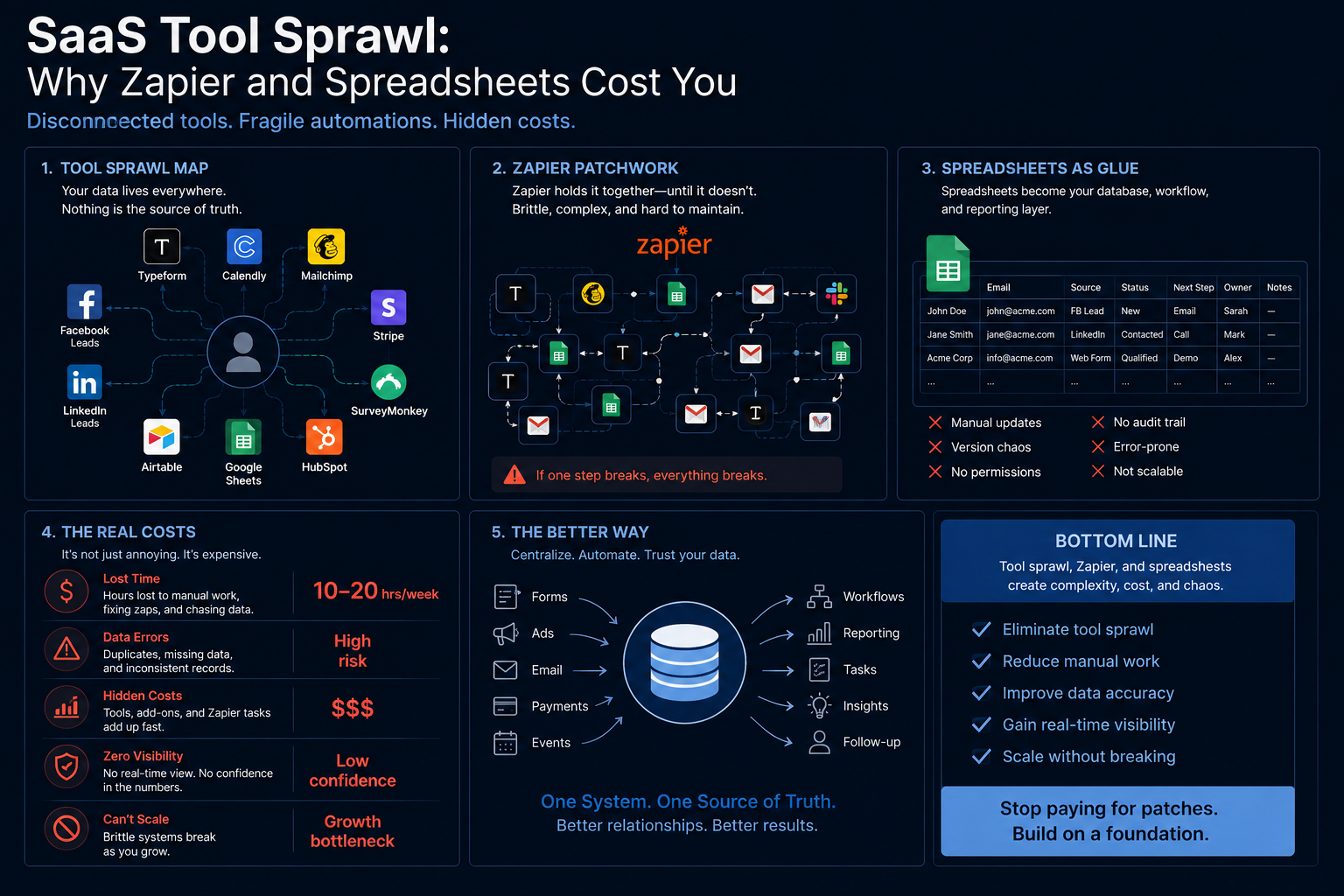
Trace a single customer through your stack.
She found you on Google. The click landed on a marketing landing page hosted somewhere — your website tool. She filled out a form — the form lived in your form vendor's system. The submission triggered a Zap that created a record in your CRM. Your CRM emailed you. You replied from your inbox tool. You scheduled a call using your calendar tool. The call happened on your phone, which logged minutes but not content. You took notes in a notes app. After the call, you opened your CRM and typed a summary. You opened your quoting tool, built an estimate, and sent it. You set a reminder in your task manager to follow up in five days. The customer texted back from your business line, which routed to a different inbox.
Five days later, you don't remember whether you followed up. You remember the customer's name, vaguely. You remember she mentioned a deadline, but you don't remember the specific date. Your CRM has the contact record. Your task manager has the reminder, marked overdue. Your quoting tool has the estimate. Your inbox has the email. Your phone log has the call. Your notes app has notes you can't find.
Everywhere your customer touched, your software wrote something down. Nowhere is your customer's story held in one place. Nowhere does anything in the stack know what should happen next.
This is the core disease.
The diagnosis
Service businesses run on a dozen disconnected systems, and nothing owns what happens next.
That sentence is doing a lot of work. Let's unpack it.
"A dozen disconnected systems." The average service business in 2026 touches 10 to 20 distinct software tools per active customer relationship. Phone, email, CRM, calendar, quoting, contracts, payments, project management, dispatching or scheduling, document storage, marketing and forms, accounting, communication apps. Each of them is good at its narrow job.
"Nothing owns what happens next." This is the architectural problem. No system in the stack is responsible for the forward motion of a relationship. The CRM stores what already happened. The task manager tracks what someone manually decided to track. The AI tool answers questions when asked. None of them is responsible for noticing that a quote sent ten days ago has gone cold, that a renewal is in eleven days, that a promise made last week is now overdue.
This responsibility — what should happen next, who should do it, with what context — is the single most important responsibility in a relationship-driven business. It is also the responsibility that, in almost every service-business stack we have looked at, is held by a human running on memory and stress.
When that human is the owner, the business has a constraint at the top. When that human is a junior employee, the business has a constraint at the bottom. Either way: the most important job in the company has no software for it.
Why each tool exists for a reason
Before we go further, credit where it is due. We are not arguing that your CRM is bad, your task manager is wasteful, or your AI tool is useless. They aren't. Each of them was designed to solve a real problem, and most of them solve it well.
CRMs store relationship data. They are databases of customers, contacts, accounts, opportunities. A good CRM gives you accurate state — who is in the funnel, who closed last quarter, who churned. CRMs are excellent at storage. That is not the same thing as ownership.
Task and project tools track what humans decide to track. Asana, Trello, Monday, ClickUp, the Apple Reminders app — they are containers for items you have explicitly written down. A task you did not write down is a task that does not exist to the system. The system does not read your inbox, listen to your calls, or watch your calendar. It tracks what you told it to track.
AI assistants and chatbots answer questions. Ask, get an answer. They are excellent at the response moment. They do not know what is about to be due tomorrow. They do not know which customer you forgot to call back. They wait for the prompt.
Communication tools transmit messages. Email, SMS, chat, calendar invites. They move information between humans. They do not interpret it. They do not act on it. They do not remember it.
The pattern: every tool in your stack is designed to be passive with respect to forward motion. They are storehouses, trackers, responders, transmitters. None of them is designed to be a driver.
The driver, in the current shape of service-business software, is a person. Usually you.
The five things nothing in your stack owns
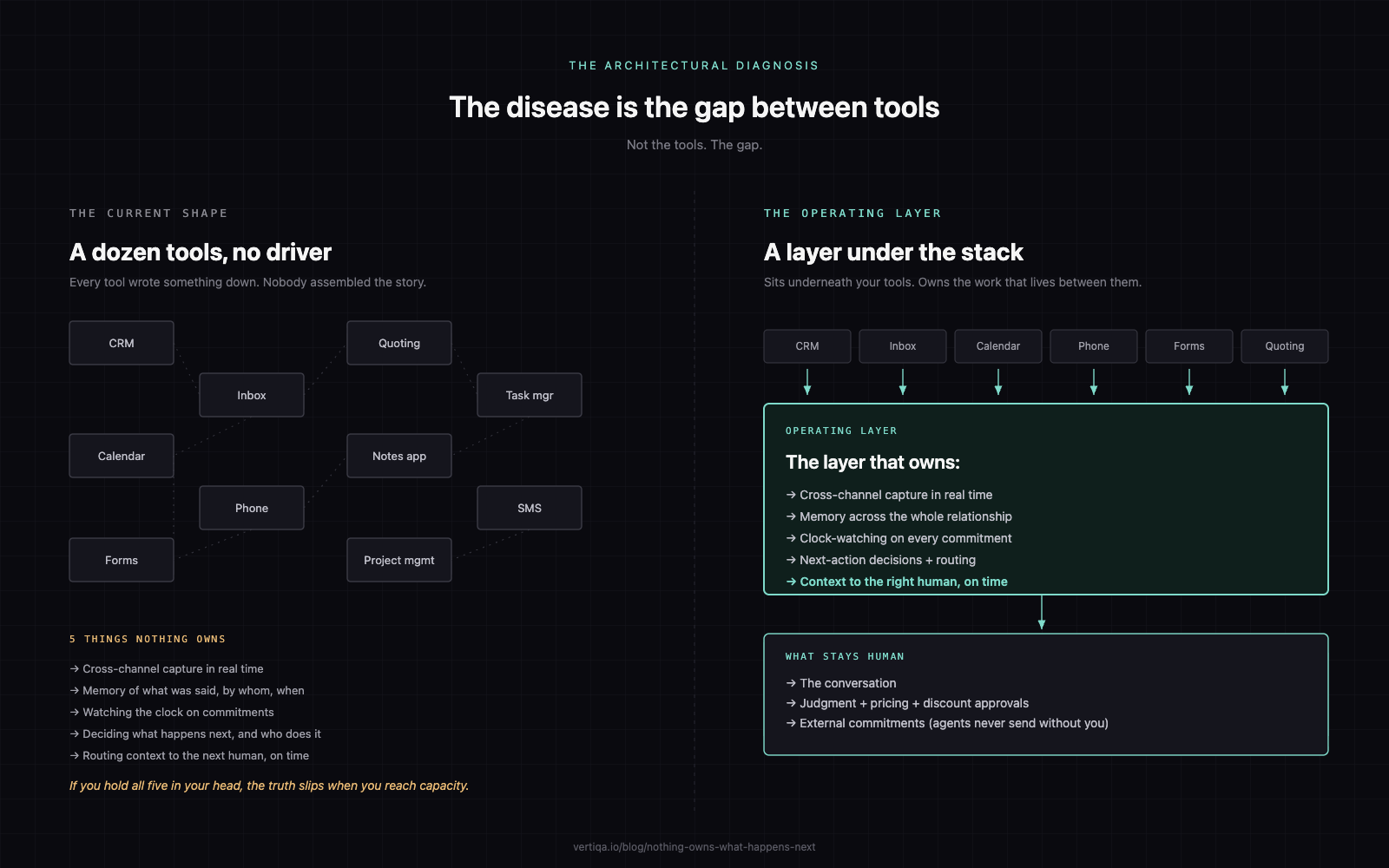
The architectural gap is concrete. There are five specific responsibilities that no category of tool in the standard stack owns. We list them because if you read this list and recognize each one as something you personally hold in your head, you will know exactly why your week feels the way it feels.
1. Cross-channel capture of every relationship event in real time
A call answered. An email received. A form submitted. A text replied to. A meeting completed. A document signed. Each of these is a relationship event. Each lives in a different tool. Nothing in your stack assembles them into one coherent timeline per customer, automatically, the moment they happen.
You can reconstruct a customer's timeline after the fact by opening six tools and reading by date. Nothing assembles it for you in real time. The assembly is your job, or it does not happen.
2. Memory of what was said, by whom, when, and what came of it
Your notes app has fragments. Your inbox has threads. Your CRM has summaries someone typed in. The unified, queryable memory of the relationship — the kind that lets a different rep pick up the thread cold next month — does not exist in any single place.
This is the difference between data and memory. Your CRM has data. The relationship has memory. They are not the same thing.
3. Watching the clock on commitments
A promise to send a quote by Friday. A renewal in eleven days. A 90-day follow-up. An estimate sitting unread for ten days. Nothing in your stack is autonomously watching the clock on these.
Your calendar might have a reminder if you put it there. Your task manager might have an entry if you wrote it down. Your CRM might have a stage if the rep updated it. The autonomous version of "watch the clock and tell somebody when it runs out, with the context attached" does not exist anywhere. It is held in the owner's head. When the owner's head reaches capacity, the watching stops.
4. Deciding what should happen next, and who should do it
This is the central job. Given the state of every relationship in your business at this moment, and given the team you have, what is the single most important thing the next person to look at this system should do?
The CRM does not know. The task manager does not know. The AI does not know, because nobody has prompted it with the full state of the business. You know — or you used to know, before the volume got past what one person can hold.
The decision-making about forward motion is the work the owner does in the shower at 6 AM. It is not in any software.
5. Routing context to the next human, at the moment they need it
When the rep picks up the call from a customer they have not talked to in six months, the rep needs the last conversation, the last quote, the last promise, the family member's name, the open ticket, the price they were quoted, and the reason they hesitated last time.
Pulling that together from six tools in 30 seconds while the phone is ringing is impossible. The rep does the call cold. The customer feels it. The relationship loses a notch. Nobody on your team will tell you this happens; they will just dread the calls and you will eventually wonder why morale is what it is.
These five responsibilities are not a feature gap. They are an architectural gap. The standard stack does not have a layer designed to hold them.
This is the shape of the problem — not a software gap
It would be tempting to read the above and conclude: okay, we need a better CRM, or a better task manager, or a more aggressive AI tool.
We do not. We need a different architecture.
The reason no individual tool will solve this is that the problem lives in the boundaries between tools. The CRM cannot watch the clock on a promise it does not know was made, because the promise was made on a phone call that the CRM never heard. The task manager cannot route the right next action to the right rep, because it does not know which rep has bandwidth, or which customer is hottest, or what was discussed last week. The AI cannot decide what should happen next, because nobody has prompted it with the full state of the business.
Each tool is operating on a fragment of the truth. The full truth lives in your head. When your head reaches capacity, the truth starts to slip — by a quote here, a renewal there, a callback that did not happen, a follow-up that died.
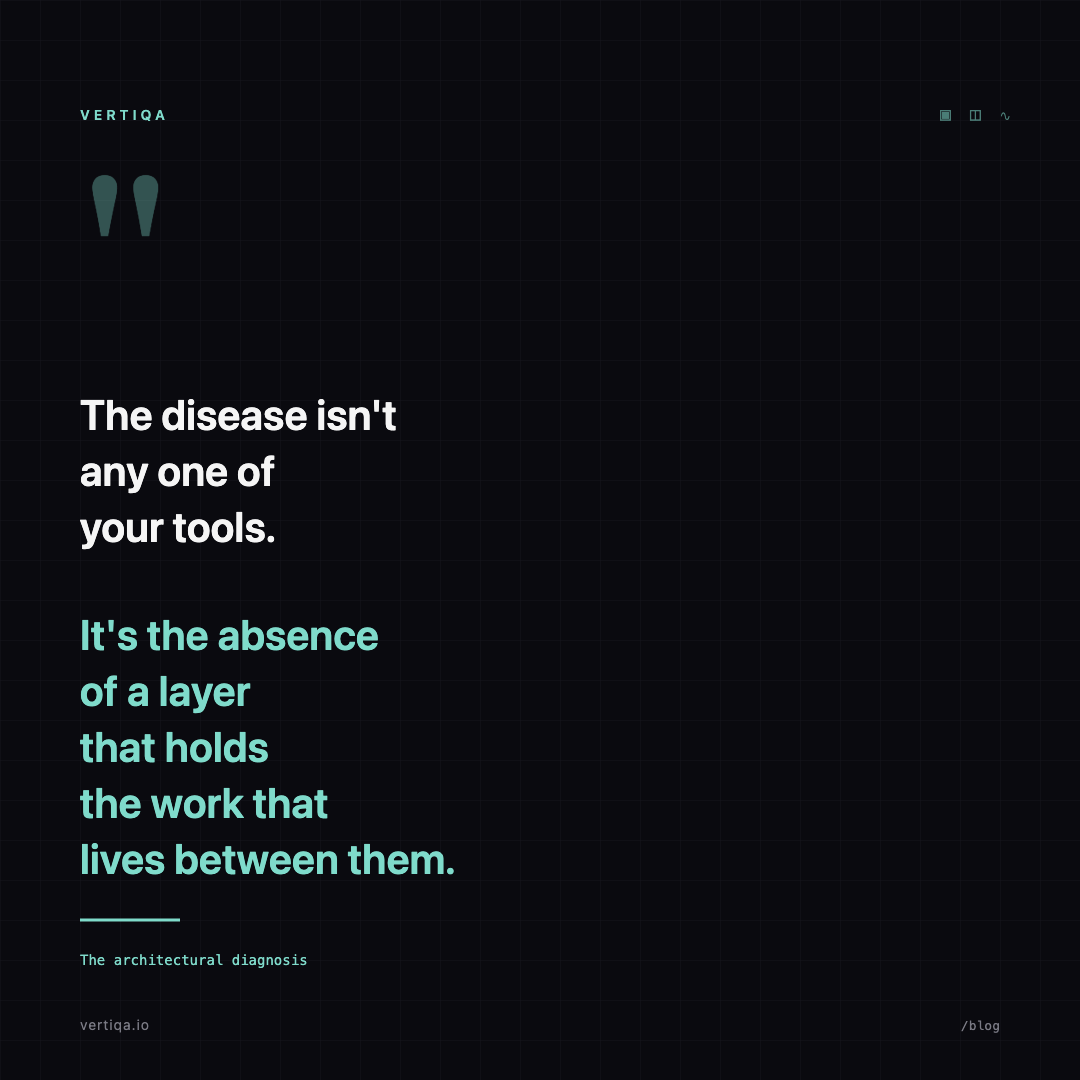
This is the architectural diagnosis: the disease isn't any one of your tools. It's the absence of a layer that holds the part of the work that lives between them.
Naming the layer is the first move toward building it.
What that layer would actually own
Imagine, for a moment, that a layer exists in your stack whose specific job is to own the five responsibilities above. Not to replace your CRM. Not to replace your task manager. Not to replace your AI tool. To sit underneath them, capture across them, hold the memory, watch the clocks, decide the next actions, and route them — with the context, to the right person, at the right time.
What changes in your day:
The 9 PM call gets captured, transcribed, structured, and lands in your pipeline before your team's first coffee tomorrow.
The promise you made on Tuesday at 3:47 PM in someone's driveway is on your queue Wednesday morning, with the right wording suggested.
The renewal in 11 days surfaces 14 days before the date — not on the day it expires.
The customer who said "call me in March" gets called the first week of March, by name, with the specific reason they hesitated last time already on the rep's screen.
The estimate that has not been touched in 10 days raises a flag on Monday, with a suggested follow-up email pre-drafted, your approval required to send.
This is not science fiction. This is what an operating layer does. It does not require your CRM to go away. It does not require your team to learn a new tool. It does not even require you to change which apps you use day to day.
It requires one architectural decision: the job of "what happens next" stops being a person and starts being a layer.
What stays human
The list of things that move to the layer is long. The list of things that stay human is shorter, and it is the more important list.
The conversation stays human. The agent drafts; the operator speaks and sends.
The judgment about which customer relationships to invest in stays human.
The pricing decisions stay human.
The discount approvals stay human.
The commitments to clients, on the record, stay human — agents do not bind your business contractually or financially without your approval (more on this here).
The layer takes the coordination work off your plate. It does not take the relationship work. It cannot. It should not.
The argument is not that humans are unnecessary in service businesses. The argument is the opposite: humans are scarce, expensive, irreplaceable, and currently buried in coordination work that software should be doing. The layer's job is to put your humans back into the parts of the work only humans can do.
Where we fit (briefly)
This is what Vertiqa is. The operating layer underneath the disconnected service-business stack. The thing that listens across phone, email, calendar, forms, chat, and your CRM; holds the memory; watches the clock; surfaces the next action with full context; and lets your humans focus on the conversations, not the stitching.
We are biased. We are also explicit about what we will not do — we never send anything externally without a human approving it, we don't generate cold outreach at scale, and we don't pretend to be a substitute for human judgment. The seven hard lines are here.
If you want to see the operating layer side: view the live demo, or hear the AI receptionist live at (678) 716-4200 — 90 seconds, no signup.
The honest cost of staying in the current shape
You can stay in the current shape. Most service businesses do. The cost is paid in three currencies, all of them invisible until you measure them.
The first is owner attention. Paid by you, every day. The hour you spend stitching your own stack together is the hour you do not spend on the work nobody else in your company can do.
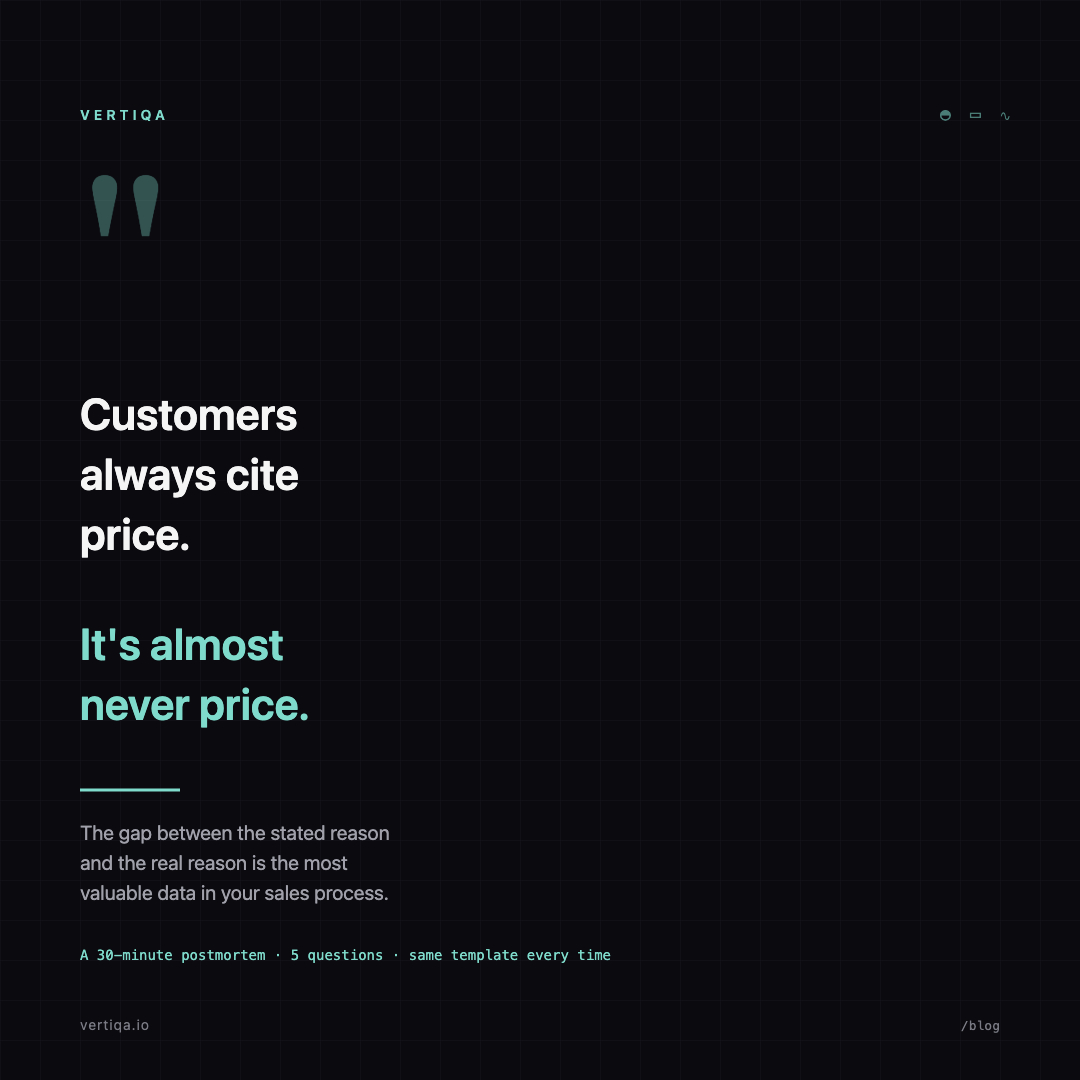
The second is slipped relationships. Paid by your customers, who do not tell you. The quote you forgot to follow up on, the renewal that went silent, the promise that died — each one a small debit, none of them noticed individually, accumulating quietly until the customer signs with someone else and tells you it was about price. (It was almost never about price.)
The third is a cap on growth. Paid in deals you will never see. Your business grows to the size your stack can hold without a layer underneath it. Past that point, every new customer makes the existing customers slightly worse. Most owners hit this ceiling, blame their team, hire more people, and find the ceiling moves up by 20% before it stops moving again. The structural answer was always a layer, not more humans.
The math compounds quietly. Then it does not.
The short version
Service businesses run on a dozen disconnected systems, and nothing owns what happens next. CRMs store data. Tools track tasks. AI answers questions. Across roughly ten apps that never share memory, no system understands the commitments, context, and follow-through that a relationship-driven business actually runs on.
The disease is not any one of your tools. It is the absence of a layer that holds the work that lives between them.
The cure is an architecture, not another app. An operating layer that captures across your channels, holds the memory, watches the clocks, decides the next actions, and routes them — with context, to the right person, at the right time.
The companies that build this layer — for themselves, by buying it, or otherwise — compound. The companies that do not will keep wondering why their close rate is fine but their pipeline keeps thinning.
The disease is named. The architecture is the cure. The decision is yours.
Related posts in this series:
Your CRM isn't broken. Your follow-through is. — the entry-level version of this argument.
The hidden cost of every tool you add. — what the disconnected stack actually costs you in dollars.
Speed-to-lead is the whole game. — what the absence of a layer costs you in pipeline.
Things we won't let our AI agents do — and why. — what the layer will not do.
— The team building Vertiqa Atlanta