It's Monday morning. You pull up your CRM. The pipeline view is clean. Every active deal has a stage. Every contact has an owner. The dashboard says everything is on track.
But three things happened last week that the CRM doesn't know about.
A prospect called at 7:42 PM on Thursday and got voicemail. By Friday morning, she'd already hired someone else.
An estimate sent ten days ago is sitting unread in a customer's inbox. No one has followed up.
A loyal customer's annual renewal is in eleven days, and no one has reached out.
The CRM is doing its job. The records are clean. And the business is bleeding.
This is the gap that no CRM was built to close. It's not a feature problem. It's a category problem. And it has a name.
Follow-through.
What CRMs were actually built for
CRMs were built to be databases of relationships. Salesforce shipped in 1999 to solve a real problem: enterprise sales teams couldn't see what each other were working on. The fix was a shared system of record where every rep typed in what they knew.
That worked. For its purpose.
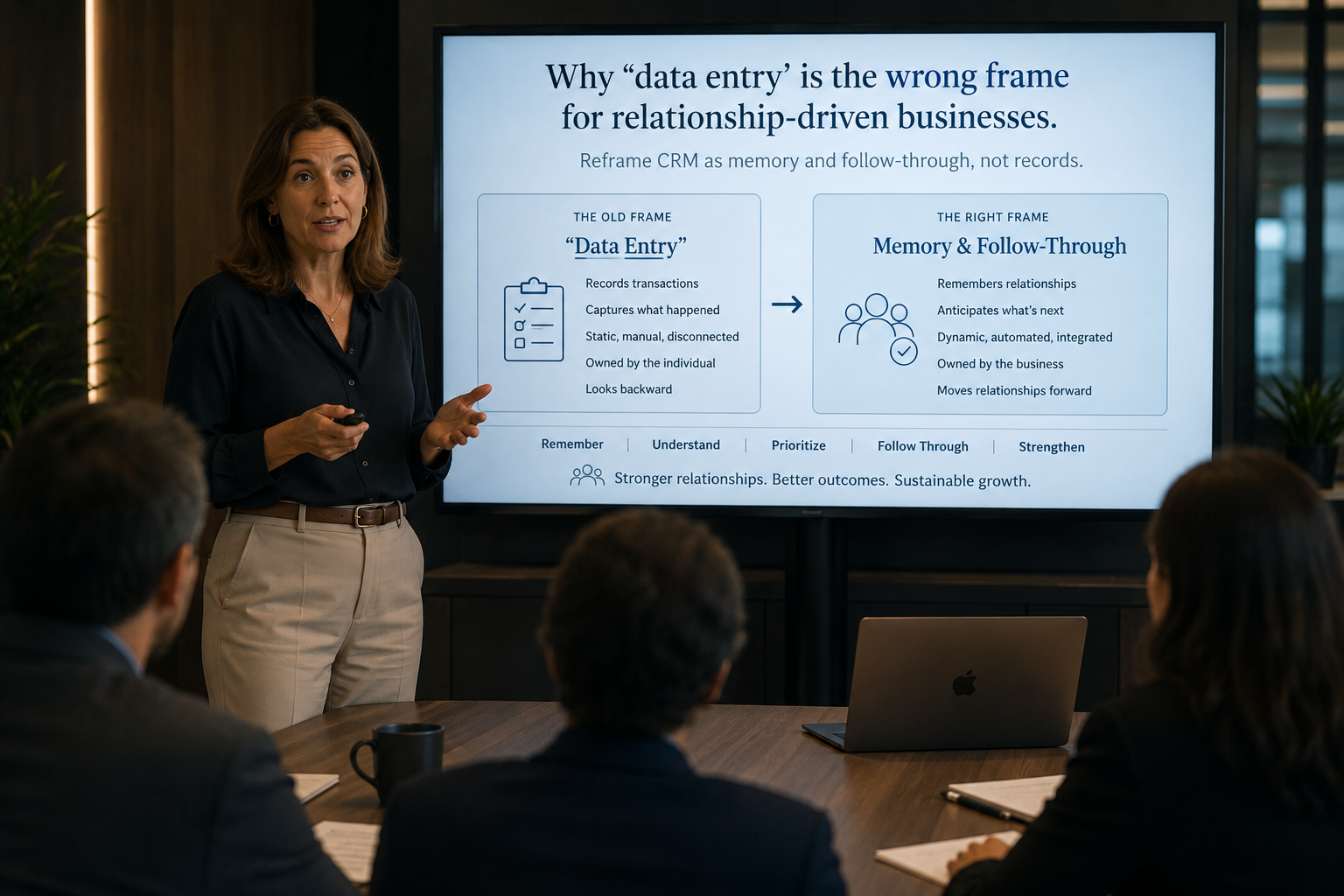
But the assumption baked into every CRM since is that typing things in is the work. Get the rep to log the call. Get the rep to update the stage. Get the rep to schedule the follow-up. The CRM is the destination; the rep is the source.
That's fine if you have ten reps doing nothing but selling. It does not work if you have three people running an HVAC business, or a four-person life insurance agency, or a IT Systems Integrator, or an equipment financing brokerage.
In those businesses, the person typing into the CRM is also the person taking the call, writing the estimate, driving to the appointment, and texting the customer back. The CRM was never going to type itself.
What relationship-driven businesses actually need
A service business doesn't fail because its records are messy. It fails because:
The 9 PM call goes to voicemail.
The estimate sent on Tuesday gets forgotten on Friday.
The renewal date passes without a conversation.
The promise made in the parking lot — "I'll send that over by Monday" — slips by a week.
The lead who said "call me back in six months" gets called back in eight, and the answer is no.
These are not data problems. They are memory and timing problems.
The business needs a system that remembers what was said, watches what was promised, and makes sure the next thing happens. A CRM doesn't do that. It was never supposed to.
We call what does that follow-through.
Follow-through is not a feature. It's the operating discipline of running a relationship business. It's the thing your best operations manager does in their head all day — and the thing every business loses when that person quits.
A working definition
Three parts. All three have to be present, or it isn't follow-through.
1. Capture
Every conversation — phone, email, voice note, web form, hallway — turns into a record without anyone retyping it. If a 9 PM call has to wait until morning for a human to log it, the call is already half-lost. The first thing the prospect will do is look for someone else.
2. Memory
The system remembers the small things. The customer's daughter's name. The fact that the prospect mentioned "we're moving in March." The objection raised on the second call that the first call wouldn't have known about. The price point quoted six months ago.
Memory is what makes a relationship feel like a relationship instead of a transaction. CRMs hold data; relationship businesses run on memory. They are not the same thing.
3. The next thing
Every promise, every renewal, every stalled deal has a clock. When the clock runs out, somebody is told — not buried in a notification feed, but surfaced as the next thing to do, with the context to do it well.
This is the part almost nothing in the typical service-business stack actually does. The reminder app reminds you. The calendar shows you the meeting. The CRM holds the record. But nothing is responsible for noticing that an estimate has gone cold and deciding what should happen now.
A CRM gives you the first part on a good day, half of the second, and almost none of the third.
Why a feature can't fix this
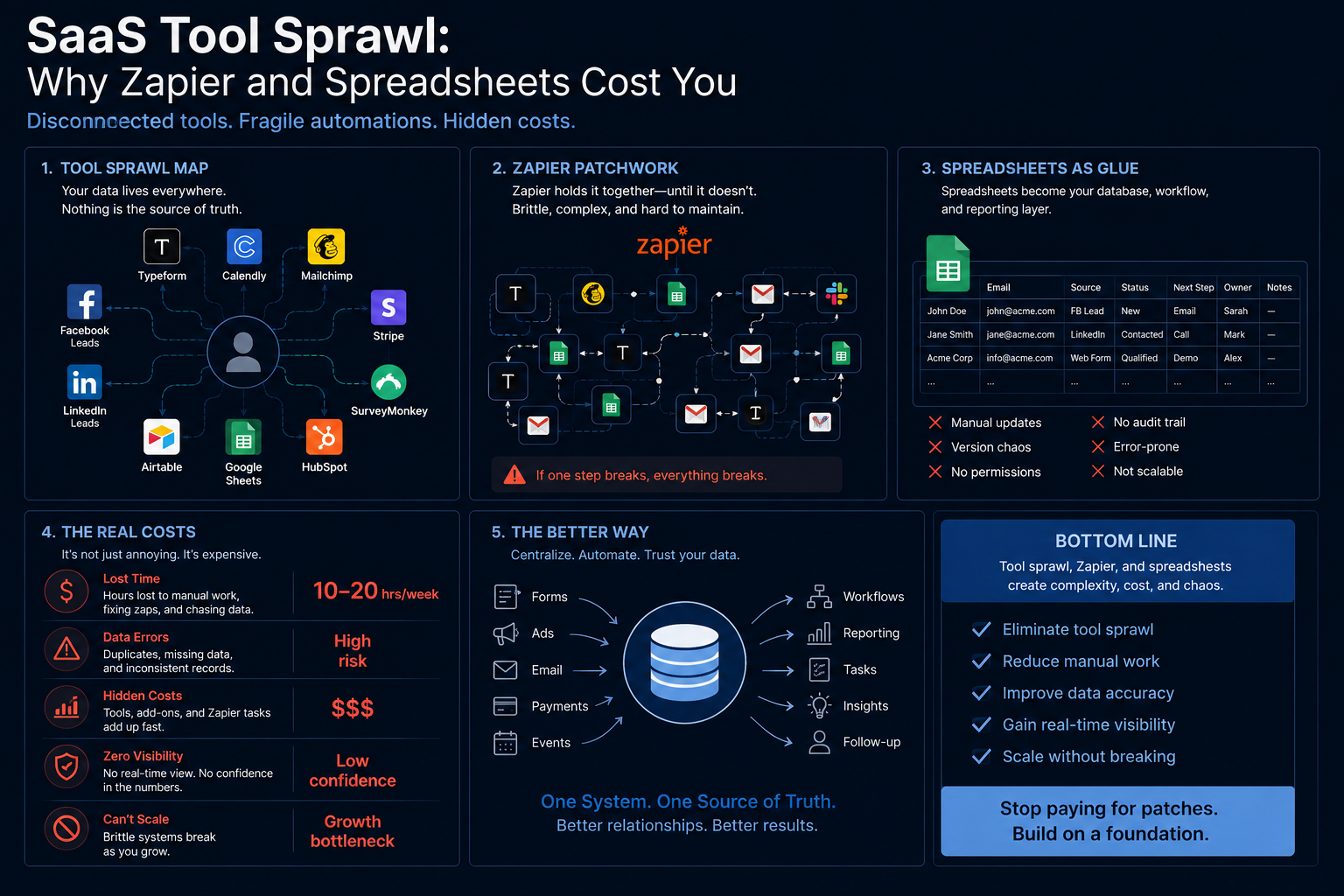
The instinct is to bolt something on. Add an AI plugin to the CRM. Add a Zapier flow. Add a no-code automation. Add an answering service for after-hours.
What you get is a stitched-together stack. Six tools, three logins, four ways the customer's name is spelled wrong, and a quiet certainty that something is falling through somewhere — you just can't tell where.
The fix is not another tool. The fix is to treat follow-through as the operating layer — the thing the business runs on, with the CRM as one organ among many.
The phone listens. The inbox listens. The calendar listens. The portal listens. They write to the same memory. The same memory tells the team what's next, in priority order, with the context to act.
That's not a CRM with a few add-ons. That's a different shape.
What changes when follow-through is the operating principle
Here is what we hear from owners who have made the shift.
The first thing they notice is what stops happening. Voicemails stop accumulating. Estimates stop sitting cold. Renewals stop being remembered the week after. The 6 AM dread of "what did we miss last week?" stops being a routine.
The second thing they notice is what starts happening. Monday morning isn't a sweep through last week's missed signals — it's a queue of warm next actions, each with the context attached. The 9 PM call lands on the right rep's pipeline before they pour their morning coffee. The customer who said "call me in March" gets called the first week of March, by name, with the right context.
The third thing they notice is what stops feeling necessary. The 6 AM check-in on the rep who's behind. The Friday "what's slipping?" Slack thread. The dread of going on vacation. Follow-through being reliable means the owner stops being the system of last resort.
That last one is the real prize. Not a cleaner CRM. Not a better dashboard. The owner getting their attention back.
What we're building
We built Vertiqa because we got tired of watching good service businesses lose deals they had already won. Not because their CRM was bad — most of them have perfectly fine CRMs — but because nothing in their stack was responsible for the next thing happening.
So we built that layer.
It answers the phone. It captures the call. It writes to the pipeline. It watches the clock on every promise. It surfaces what's next, with the context to do it well. And — this is important — it never sends anything externally without a human approving it. Agents draft. Owners send. That line does not move.
Call it an agentic operations system. Call it a follow-through layer. Call it the thing that does what your best ops manager does, except it doesn't quit, and it doesn't sleep through the 9 PM call.
What we don't call it is a CRM. Your CRM is fine. It just isn't the thing that decides whether last Thursday's call became this Monday's deal.
That part is on follow-through. And follow-through is what we build.
Hear it for yourself. Call our AI receptionist live at (678) 716-4200 — 90 seconds, no signup. Or See the Live Demo of HVAC Business (or) Live Demo of IT Services Business